If You Sell Handmade Skincare, Your Label Matters

It’s July, which usually means market season is in full swing.
For many indie makers, fairs, festivals, farmers markets, craft shows, pop-ups, and local events are not just “extra” selling opportunities. They are a major part of the year’s income. This is the season when products are being packed, labeled, displayed, sampled, purchased, gifted, and taken home by real customers.
That makes this the right time to talk about something that is not as exciting as a new scent blend or a beautiful booth setup, but matters just as much: product labels and website content.
This post is written from a U.S. handmade seller perspective. If you sell outside the United States, check the cosmetic, consumer product, labeling, and advertising rules for your own country or region.
If you sell handmade skincare, soap, bath and body products, hair products, balms, scrubs, lotions, creams, oils, or any other topical product, your label matters.

When you are making products for yourself, your label can be as simple or informal as you want it to be.
But once you sell that product, the responsibility changes.
Your product label and website content become part of the customer’s buying decision. A customer is not just choosing a scent, a texture, or a pretty jar. They are deciding whether that product is appropriate for their skin, their allergies, their household, their children, their personal comfort level, and sometimes their medical or sensitivity concerns.
That means clear labeling is not just a design choice. It is part of responsible selling.
And before anyone feels called out, I want to be clear: a lot of us have learned this as we went. I used to mis-label products by using trade names instead of proper ingredient names because I did not fully understand the difference at the time. Once I learned better, I changed how I labeled.
That is the point of this conversation.
Not shame.
Not fear.
Just doing better once we know better.
Your Website Matters Too
The physical product label matters because that is where proper labeling requirements apply. But if you sell online, your website content matters too.
A customer with a known allergy should not have to purchase your product first, wait for it to arrive, and then read the label to find out whether they can use it.

If someone is allergic to lanolin, certain nut oils, fragrance, essential oils, botanicals, bee-derived ingredients, menthol, camphor, salicylates, or a specific preservative, they need enough information before they buy.
No, your website may not be the same thing as the physical product label. And no, this does not mean you have to publish your exact formula, percentages, process, suppliers, infusion ratios, or formulation method.
But in my opinion, if you are selling products that people put on their skin, you should be as transparent as reasonably possible before purchase.
At the very least, if your product contains ingredients that are known allergens or common sensitivity concerns, say that clearly.
Ingredient Lists Are Not Formula Theft
This is one of the biggest fears I see from makers: “If I list the ingredients, someone will copy my formula.”
But listing ingredients is not the same thing as giving away your formula.
A proper ingredient declaration does not reveal:
your exact percentages
your phase structure
your process
your heating and cooling method
your emulsification strategy
your thickener system
your exact supplier choices
your development work
your batch notes
your testing history
It simply tells the customer what is in the finished product.
Protecting your formula is reasonable. But hiding basic ingredient information from customers is not the same thing as protecting intellectual property.
If you are selling a product for the skin, the customer deserves to know what they are putting on their body.

Trade Names Are Not the Same as Proper Ingredient Names
This is a mistake many makers make in the beginning, and I made it too. I used to only list trade names rather than their proper INCI names.
A trade name is what a supplier calls an ingredient or ingredient blend. It may be catchy, branded, easy to remember, or marketed toward makers. But that is not automatically the proper name that belongs on your cosmetic label.
INCI stands for International Nomenclature Cosmetic Ingredient. INCI names are systematic names used internationally to identify cosmetic ingredients.
In the U.S., cosmetic ingredient names must follow the appropriate labeling rules, and the FDA provides guidance on ingredient nomenclature. The Personal Care Products Council also provides INCI resources for identifying cosmetic ingredients.
The practical point for makers is simple: do not rely only on the supplier’s marketing name.
A supplier may sell an ingredient under a pretty trade name, but the actual cosmetic ingredient name may be something completely different. If you only list the supplier’s trade name, your customer may not know what the ingredient actually is.
That matters because people are not usually allergic to a marketing name. They are allergic or sensitive to the actual ingredient.

Allergen Transparency Is a Safety Issue
This is where transparency matters most.
Not every ingredient is dangerous. That is not the point. The point is that customers have different allergies, sensitivities, health situations, ethical concerns, and personal boundaries.
Some customers need to avoid certain nut oils. Some avoid lanolin. Some react to fragrance. Some react to essential oils. Some are sensitive to menthol or camphor. Some avoid salicylates. Some need to know whether a product contains bee-derived ingredients, animal-derived ingredients, oat-derived ingredients, wheat-derived ingredients, latex-related materials, strong exfoliants, acids, or certain preservatives.
That does not mean every one of those ingredients is bad.
It means the customer needs enough information to make an informed decision.
“Trust me, it’s natural” is not useful information for someone with a known allergy.
“Proprietary blend” is not useful information for someone trying to avoid a specific ingredient.
“Made with herbs and oils” is not enough information for someone who needs to know whether the product contains something they react to.
If your product contains common allergens or ingredients many customers may need to avoid, be clear about it.

Allergen and Sensitivity Notes Are Helpful, But They Do Not Replace Proper Labeling
Ideally, your product has a proper ingredient declaration. But when it comes to website content, even a basic allergen or sensitivity notice is better than saying nothing.
Examples of useful transparency statements may include:
Contains nut-derived oils.
Contains lanolin.
Contains fragrance.
Contains essential oils.
Contains menthol.
Contains camphor.
Contains salicylate-containing ingredients.
Contains bee-derived ingredients.
Contains oat-derived ingredients.
Contains exfoliating acids.
Contains botanical extracts.
Patch testing is recommended.
Avoid use on broken or irritated skin.
Not intended for use around the eyes.
Not intended for children unless advised by a qualified professional.
This is not about scaring people away from your product. It is about respecting the customer enough to let them decide whether the product is right for them.
And honestly, the customer who needs to avoid your product because of an allergen was never the right customer for that product anyway. Letting them know before they buy protects them, and it protects you.
Fragrance transparency is also moving in a more accountable direction. Under MoCRA, FDA is required to establish fragrance allergen labeling requirements for cosmetics. That does not mean sellers should guess future requirements, but it does show that allergen transparency is not a fringe concern.

Cosmetic Claims vs. Drug Claims
This is another area where handmade sellers need to be careful.
A cosmetic product is generally intended to cleanse, beautify, promote attractiveness, or alter the appearance of the body. That includes claims around moisturizing, softening, smoothing, cleansing, conditioning, improving the feel of skin or hair, or improving the appearance of dryness.
Drug claims are different. A product can move into drug territory based on its intended use, and intended use can be shown through the words used to market the product.
That means your product category is not only about what you think you made. It is also about how you sell it.
Examples of claim areas to handle carefully include:
pain relief
inflammation
arthritis
neuropathy
eczema
psoriasis
acne treatment
fungal infections
wound healing
antibacterial claims
antiviral claims
SPF or sun protection
hormone claims
circulation claims
hair growth or hair regrowth
stimulating hair follicles
reducing hair loss
treating thinning hair
sleep, anxiety, or stress treatment claims
There is a big difference between saying a product helps skin feel softer and saying it treats eczema.
There is a big difference between saying a hair product helps reduce the appearance of dryness or breakage and saying it grows hair, regrows hair, stimulates follicles, or treats hair loss.
There is a big difference between saying a body butter moisturizes dry skin and saying it relieves pain or inflammation.
The words you use matter.
You can accidentally change the regulatory category of a product with your marketing claims.

Online Content Can Create Claims Too
Your physical label is not the only place claims happen.
Your website content, product descriptions, Etsy listings, social media captions, hashtags, product names, FAQ wording, before-and-after photos, and customer testimonials can all shape the intended use of the product.
Testimonials are a big one.
If a customer says your product “cleared my eczema,” “fixed my acne,” “grew my hair back,” “relieved my pain,” or “healed my rash,” and you choose to feature that testimonial in your marketing, you may be adopting that claim.
The same goes for hashtags. If you are using hashtags that suggest disease treatment, pain relief, hair regrowth, or other therapeutic results, those hashtags are still part of how the product is being marketed.
You do not get to make drug-style claims indirectly and then say, “I didn’t put it on the label.”
Marketing is marketing.

Ingredients Can Matter Too
Claims are a major part of the issue, but ingredients can matter too, especially when an ingredient has an established over-the-counter drug use or when the product is marketed in a way that supports a therapeutic purpose.
Examples of product areas where sellers need to be especially careful include:
sunscreen products
acne products
antidandruff products
antiperspirants
skin protectants
antifungal products
external analgesic or counterirritant products
medicated lip products
products making hair regrowth or hair-loss claims
A product does not get a free pass because it is handmade, natural, botanical, small-batch, or sold by an independent maker.
If it is sold to the public, the seller needs to understand what category they are selling in.

Soap Is Not Always “Just Soap”
Since many handmade sellers also make soap, this needs to be said clearly.
Soap can fall under different rules depending on what it is made from and how it is marketed. A true soap has a different regulatory pathway than a cosmetic or drug product, but that does not mean every bar with the word “soap” on it is automatically treated the same way.
If a soap is marketed only as soap, meaning its main purpose is cleansing and it meets the definition of true soap, that is one thing.
But if the product is marketed to moisturize, deodorize, treat acne, soothe eczema, fight fungus, relieve itching, reduce inflammation, or provide other cosmetic or drug-type benefits, the category can change.
The word “soap” is not a magic shield.
What you claim matters.

Color Additives Matter
Colorants are another area handmade sellers should not ignore.
Cosmetic color additives must be approved for their intended use. Not every colorant sold to makers is automatically approved for every type of cosmetic product.
A colorant that may be suitable for soap is not automatically suitable for lips, eyes, bath bombs, leave-on skincare, or products used around mucous membranes.
That matters for micas, dyes, lakes, neons, glitters, oxides, ultramarines, botanicals, and other colorants commonly used in handmade products.
Do not assume “skin safe” means approved for every product category or every application area.
Check the intended use.

Preservation and Microbial Safety Matter
This blog is mostly about labeling and transparency, but we cannot talk about responsible selling without mentioning microbial safety.
If a product contains water, hydrosols, aloe juice, botanical teas, milks, water-based extracts, or any other water-containing ingredient, preservation is not optional from a safety standpoint.
“Use quickly” does not automatically make an improperly preserved product safe to sell.
“Keep refrigerated” does not automatically make an improperly preserved product safe to sell.
“Patch test first” does not fix poor preservation.
If you are selling water-containing products, you need to understand preservation, packaging, contamination risk, shelf life, and appropriate testing. A pretty label does not make an unsafe product safe.

Directions and Warnings Matter
A good label is not only about the ingredient list. Depending on the product, customers may also need directions and warnings.
They may need to know:
whether the product is leave-on or rinse-off
where to apply it
how often to use it
whether to avoid the eyes
whether to avoid mucous membranes
whether to avoid broken or irritated skin
whether children should avoid it
whether it may increase sun sensitivity
whether patch testing is recommended
whether it is intended for face, body, scalp, lips, feet, or hair
whether the product contains strong fragrance, essential oils, acids, exfoliants, or warming/cooling ingredients
A beautiful label that does not tell the customer how to use the product safely is not doing its job.
And to be very clear: “patch test first” can be useful advice, but it is not a legal shield and it does not replace proper formulation, preservation, labeling, directions, warnings, or transparency.

MoCRA Does Not Disappear Just Because You Are Small
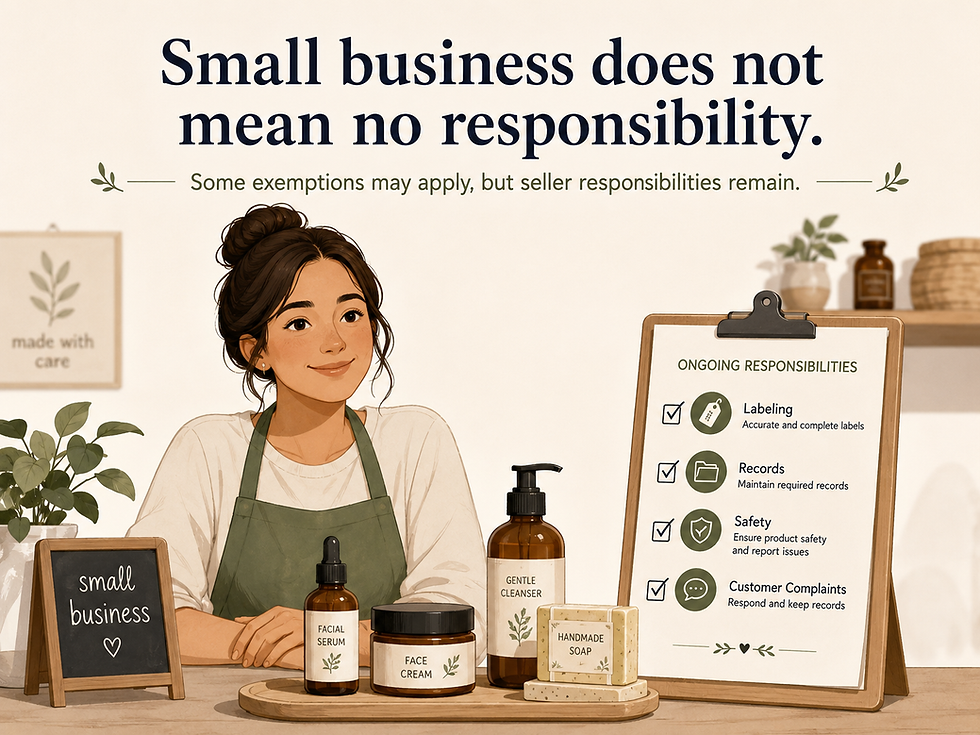
Some small businesses may qualify for certain exemptions under MoCRA, including some facility registration and product listing exemptions. But that does not mean “small handmade seller” equals “no responsibility.”
Even if a business qualifies for certain small-business exemptions, that does not erase the responsibility to sell safe, properly labeled products and keep appropriate records.
Makers who sell should understand the basics of MoCRA, including serious adverse event reporting, safety substantiation, recordkeeping, and the changing expectations around cosmetic business responsibility.
You do not need to be afraid of that.
But you do need to stop pretending it does not apply to the handmade world at all.
Serious Adverse Event Reporting and Complaint Records
Makers who sell need a system for customer complaints, especially complaints involving reactions, burns, infections, eye injuries, hospitalization, or anything serious.
If a customer reports a serious problem, you need more than “I’m sorry that happened.”
You need records.
You need the product label.
You need batch information.
You need to know what was sold, when it was made, what ingredients were used, and whether other complaints came from the same batch.
Under MoCRA, responsible persons must report serious adverse events associated with cosmetic products in the United States to FDA within 15 business days, and the report must include a copy of the product label.
That is another reason proper labeling and batch records matter.
Safety Substantiation
Makers should not sell products based only on “I used it and I’m fine.”
Your product should not be sold just because it looks good in the jar, smells nice, or worked for your friend.
You need a reasonable basis for believing the product is safe for its intended use.
That includes understanding the ingredients, the usage rates, the product category, the preservative system when needed, the packaging, the directions, the target user, and the claims being made.
Handmade does not mean exempt from safety.
Natural does not mean automatically safe.
Small-batch does not mean low-risk.

Batch Records and Traceability
Batch records are not glamorous, but they are essential.
If a customer reports a problem, the seller needs to know:
when the batch was made
what ingredients were used
supplier and lot information when available
how many units were made
how many units were sold
where those units went
whether other complaints came from the same batch
This matters for customer service, refunds, adverse event reporting, recalls, reformulation decisions, and basic professionalism.
If you sell products, you need records.
Contact Information Needs to Actually Work
A label should not just look pretty. Customers need a way to contact the responsible business.
An Instagram account is not the same thing as a clear business contact path.
If someone has a question, reaction, complaint, or safety concern, they need to know how to reach you.
MoCRA also includes requirements around domestic contact information for adverse event reporting on cosmetic labels.
The practical point is simple: if you sell it, customers need a real way to contact the responsible seller.
Marketing Claims Need Discipline
This is not strictly label format, but it belongs in this conversation because product labels and website content work together.
Makers should be careful with broad claims like:
chemical-free
toxin-free
non-toxic
clean
hypoallergenic
safe for everyone
pregnancy-safe
kid-safe
preservative-free
dermatologist-approved
clinically proven
Some of those claims may be hard to substantiate. Some may be misleading. Some may create customer trust issues. Some may imply a level of testing or safety review that the product has not actually had.
This does not mean you cannot talk about your product honestly. It means your claims should match what you can actually support.
If you say something is dermatologist-approved, you need to be able to support that.
If you say something is clinically proven, you need to know what that means and have the evidence to back it up.
If you say something is preservative-free, you need to be very sure that statement is accurate and that the product is still safe for its intended use.
Environmental and Origin Claims Also Need Support
If a seller says Made in USA, eco-friendly, biodegradable, reef-safe, sustainable, plastic-free, compostable, cruelty-free, vegan, or zero-waste, those claims should be true and supportable.
These claims are not just cute marketing words. They shape customer expectations.
Environmental marketing claims should not be vague, exaggerated, or misleading. Origin claims such as “Made in USA” also need to be used carefully.
The same basic rule applies here too: if you cannot support the claim, do not make the claim.

Transparency Protects the Customer and the Seller
Transparent labeling is not just about rules. It is also good business.
Clear product labels and honest website content help:
reduce customer confusion
reduce avoidable reactions
reduce refund requests
reduce angry messages
build trust
show professionalism
help customers repurchase confidently
create better records if there is ever a complaint
make your business look more credible
Transparency does not weaken your brand. It strengthens it.
Customers do not need your entire formula notebook. But they do need enough information to make a safe and informed decision.
A Practical Labeling and Website Checklist for Sellers
Before selling a handmade cosmetic, skincare, soap, hair, bath, or body product, ask yourself:
Is the product identity clear?
Is the net weight or volume listed?
Is my business name and contact information present?
Is there a real way for customers to contact me?
Are the ingredients listed properly?
Am I using proper ingredient names instead of supplier trade names?
Are the ingredients listed in the correct order?
Does the product contain fragrance, essential oils, nut oils, lanolin, menthol, camphor, salicylates, bee-derived ingredients, or other common sensitivity concerns?
Does my website give customers enough information before they buy?
Are my claims cosmetic claims, or have I crossed into drug-claim territory?
Have I made claims about pain, inflammation, disease, healing, infection, hair growth, hair loss, SPF, or treatment of a condition?
Do my product descriptions, social captions, hashtags, testimonials, or before-and-after photos create claims I should not be making?
Are my colorants approved for the intended product use?
If the product contains water, is it properly preserved?
Do I need clearer directions?
Do I need warnings or caution statements?
Do I have batch records?
Do I have supplier documentation?
Do I have a way to handle customer complaints or adverse reactions?
Can I support the claims I am making?
If you sell, these are not dramatic questions. They are basic responsible-seller questions.
The Bottom Line
Selling handmade products is not just about making something pretty, natural, trendy, or nice-feeling.
It is about giving people enough information to choose wisely.
You do not have to give away your formula to be transparent.
You do not have to share your percentages to be responsible.
You do not have to pretend you knew everything from day one. Most of us did not.
But once you learn better, you need to do better.
If you sell products that people put on their skin, your customer deserves clear labeling, honest website content, and claims that stay within the lane your product actually belongs in.
If we want handmade skincare to be taken seriously, we have to label it like we take the customer seriously.
~Lissa~

Sources
FDA — Cosmetics Labeling Guidehttps://www.fda.gov/cosmetics/cosmetics-labeling-regulations/cosmetics-labeling-guideSupports cosmetic label basics: identity, net quantity, business information, warnings, and ingredient declaration.
21 CFR 701.3 — Designation of Ingredientshttps://www.ecfr.gov/current/title-21/chapter-I/subchapter-G/part-701/subpart-A/section-701.3Supports the requirement that cosmetic ingredients be declared in descending order of predominance.
FDA — Is It a Cosmetic, a Drug, or Both? Or Is It Soap?https://www.fda.gov/cosmetics/cosmetics-laws-regulations/it-cosmetic-drug-or-both-or-it-soapSupports the cosmetic vs. drug vs. soap discussion and the role of intended use.
FDA — Cosmetics & U.S. Lawhttps://www.fda.gov/cosmetics/cosmetics-laws-regulations/cosmetics-us-lawSupports claim boundaries, including claims that affect structure/function or treat conditions, such as hair-growth-type claims.
FDA — Cosmetic Ingredient Nameshttps://www.fda.gov/cosmetics/cosmetics-labeling/cosmetic-ingredient-namesSupports the section on proper ingredient names versus trade names.
Personal Care Products Council — INCI / wINCIhttps://www.personalcarecouncil.org/resources/inci/Industry support for INCI names and cosmetic ingredient identification.
FDA — Small Businesses & Homemade Cosmetics: Fact Sheethttps://www.fda.gov/cosmetics/resources-industry-cosmetics/small-businesses-homemade-cosmetics-fact-sheetSupports small handmade seller responsibility, product safety, proper labeling, and color additive concerns.
FDA — Modernization of Cosmetics Regulation Act of 2022 (MoCRA)https://www.fda.gov/cosmetics/cosmetics-laws-regulations/modernization-cosmetics-regulation-act-2022-mocraSupports MoCRA responsibilities, serious adverse event reporting, safety substantiation, and fragrance allergen labeling direction.
Marie Gale — Soap and Cosmetic Labeling, 4th Editionhttps://www.mariegale.com/soap-and-cosmetic-labeling-book/Maker-friendly industry reference for handcrafted soap and cosmetic labeling.
FTC — Green Guideshttps://www.ftc.gov/news-events/topics/truth-advertising/green-guidesSupports the section on environmental marketing claims such as eco-friendly, biodegradable, sustainable, compostable, recyclable, and similar claims.


Comments