DIY Sunscreen Is Where Handmade Skincare Needs to Stop

I make skincare products.
I teach other people how to make skincare products.
I believe in handmade formulation, ingredient education, proper procedure, preservation, stability, testing, and understanding what we are actually making before we put products on our skin or into someone else’s hands.
But there is a hard line.
DIY sunscreen is where handmade skincare needs to stop.
This is not me being anti-handmade, it’s literally what I’ve been doing for over 24 years. This is not me saying every store-bought product is perfect, or that every commercial sunscreen feels good on every person’s skin.
This is me saying that sunscreen is not just another skincare recipe.
Once a product is being used to protect skin from ultraviolet radiation, we are no longer talking about a simple balm, lotion, butter, salve, or “natural skincare recipe.” We are talking about a sun protection product that needs to be properly formulated, properly tested, legally compliant, and proven to work as a finished product.
And no, adding zinc oxide to melted tallow does not automatically create sunscreen.

Why I’m Writing This
Recently, I saw a conversation in a natural skincare group where someone asked for a homemade sunscreen recipe.
My response was simple:
“Don’t make your own sunscreen. Skin cancer is no joke. Leave sunscreen to the professionals. Go to the store and buy a good one.”
That should not have been controversial.
But, of course, it was.
The comments that followed included claims like:
“The sun doesn’t cause cancer.”
“Sunscreen causes cancer.”
“Tallow, red raspberry seed oil, carrot seed oil, and nano zinc are enough for personal use.”
“Red raspberry seed oil has excellent SPF protection.”
“Just make a tallow balm with zinc oxide and cocoa powder.”
“Coconut butter is a natural sunscreen.”
“Take your sunglasses off so your eyes can respond to the sun and protect your skin.”
“Cutting out seed oils keeps you from burning.”
This is exactly how misinformation spreads in the handmade and natural skincare world. It sounds confident and authoritative by the person saying it. It sounds “natural.” It sounds like someone discovered secret knowledge that dermatologists, toxicologists, cosmetic chemists, regulatory agencies, and sunscreen testing labs somehow missed.
But confidence is not evidence.
And when we are talking about UV exposure and skin cancer risk, misinformation is not harmless.

Sunscreen Is Not Cosmetic Skincare
This is the part many DIY makers skip right over.
A lotion is a cosmetic.
A body butter is a cosmetic.
A balm is usually a cosmetic.
A tallow salve can be a cosmetic, depending on how it is marketed.
But sunscreen is different.
In the United States, sunscreen products are regulated under the FDA’s over-the-counter drug framework. FDA’s current sunscreen order sets the requirements for marketing OTC sunscreen products, and FDA guidance refers to “OTC sunscreen drug products” with specific labeling and effectiveness testing requirements.
That means sunscreen is not in the same category as a body butter, balm, soap, facial oil, or goat milk lotion.
Most handmade skincare makers are not operating as compliant OTC drug manufacturers. We are not set up for drug manufacturing compliance, drug facts labeling, drug listing, SPF testing, broad-spectrum testing, water-resistance testing, or the regulatory burden that comes with selling products intended to prevent sunburn or protect against UV damage.
So, this is not just a formulation issue.
It is also a legal and regulatory issue.
Selling or marketing a product as sunscreen, SPF, sunblock, UV protection, or sun protection moves it out of ordinary cosmetic territory and into drug-product territory. Most of us in the handmade skincare space are not licensed, registered, equipped, or compliant to manufacture and sell OTC drug products.
That alone should be enough reason to stay far away from DIY sunscreen claims.

The Sun Absolutely Can Contribute to Skin Cancer
Let’s get this out of the way first.
The claim that “the sun doesn’t cause cancer” is not factually correct.
The CDC states that most skin cancers are caused by too much exposure to ultraviolet, or UV, light. UV rays are an invisible type of radiation that come from the sun, tanning beds, and sunlamps, and they can damage skin cells.
The American Cancer Society also states that most skin cancers are a result of exposure to UV rays in natural sunlight, and that UV rays from sunlight and tanning devices are a risk factor for all types of skin cancer.
That does not mean every single skin cancer case has one simple cause. Skin cancer risk can also be influenced by skin type, genetics, immune status, personal history, family history, mole patterns, tanning bed use, occupational exposure, and other factors.
But pretending UV radiation is not a major risk factor is not “natural wisdom.”
It is dangerous misinformation.

Sunscreen Is Judged by Finished Product Performance
A properly made sunscreen is not judged by whether the ingredient list sounds natural.
It is judged by whether the finished product actually performs.
The FDA sunscreen framework includes SPF testing, broad-spectrum testing, labeling requirements, directions, warnings, and water-resistance testing when a water-resistance claim is made. FDA guidance also states that OTC sunscreen drug product labeling must be submitted to FDA under drug listing requirements.
That is a completely different world from:
“Add 1–2 tablespoons of zinc oxide.”
“Stir until it cools.”
“Pour it into a deodorant tube.”
“Tint it with cocoa powder.”
“Check Pinterest.”
That is not sunscreen formulation.
That is guesswork.
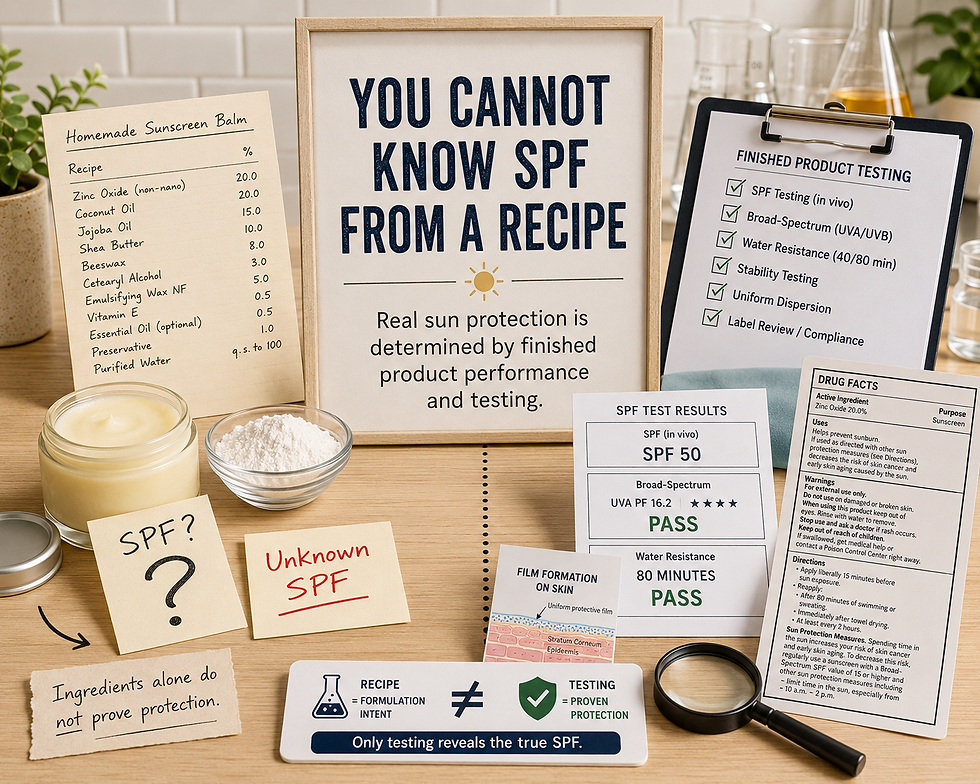
You Cannot Know SPF From a Recipe
One of the biggest problems with homemade sunscreen recipes is the false belief that you can calculate SPF from an ingredient list.
You cannot.
You cannot look at a tallow balm with zinc oxide and know the SPF.
You cannot look at a percentage of zinc oxide and know the SPF.
You cannot look at red raspberry seed oil, carrot seed oil, coconut oil, shea butter, cocoa powder, or tallow and know whether the finished product protects against UV radiation.
SPF is not assigned because an ingredient has a reputation online. SPF is determined by testing the finished product.
And SPF is not the only thing that matters.
A real sunscreen needs to be evaluated for things like:
SPF performanceUVA protectionbroad-spectrum performancefilter dispersionfilm formationrub-off resistancewater resistance, when claimedstability over timemicrobial safety, if water-containingpackaging compatibilityrealistic use and reapplication instructions
That is why DIY sunscreen is not the same as making a balm or body butter.
A homemade balm may feel nice. It may smell nice. It may look nice. It may even contain zinc oxide.
That does not mean it is a reliable sunscreen.
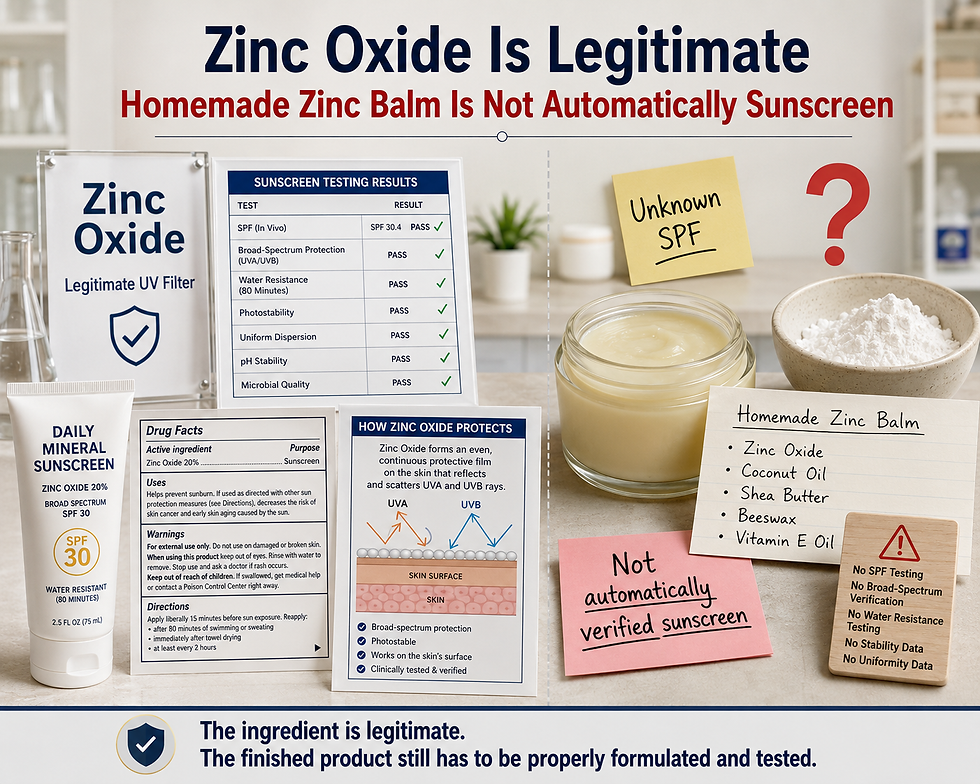
Zinc Oxide Is Legitimate — Homemade Zinc Balm Is Not Automatically Legitimate Sunscreen
Zinc oxide is not the villain here.
Zinc oxide is a legitimate sunscreen active when used correctly in a properly formulated and properly tested sunscreen product.
But the ingredient itself is not the same thing as a finished sunscreen.
That distinction matters.
Zinc oxide has to be properly dispersed. It has to remain evenly distributed in the finished product. It has to form a uniform protective film on the skin. The formula has to be tested to verify SPF and broad-spectrum protection.
If zinc oxide clumps, settles, agglomerates, or distributes unevenly, you do not have consistent protection. One swipe may deposit more zinc. Another area may get very little. A thick white streak does not prove even UV protection, and a tinted balm does not prove broad-spectrum performance.
That is why “I stirred it until it started cooling” is not a sunscreen manufacturing method.
It is also why kitchen measurements are a giant red flag.
A recipe that says “1–2 tablespoons of non-nano zinc oxide” is not a professional formula. It is not percentage-based. It is not standardized. It does not account for the exact grade of zinc oxide, particle behavior, dispersion quality, base structure, film formation, or testing.
That is not a sunscreen.
That is a hope and a prayer in a deodorant tube.

“Non-Nano” Does Not Fix the Problem
Another common natural-world claim is that using “non-nano zinc oxide” makes the recipe safe and effective.
No.
Nano versus non-nano does not change the central issue.
The issue is not simply whether the zinc oxide is nano or non-nano. The issue is whether the finished product has been properly formulated and tested to prove that it provides the claimed protection.
Non-nano zinc oxide in a poorly dispersed balm is still a poorly tested product.
Non-nano zinc oxide in melted tallow still does not tell you SPF.
Non-nano zinc oxide in a Pinterest recipe still does not prove UVA protection, water resistance, stability, or even coverage.
The finished product is what matters.
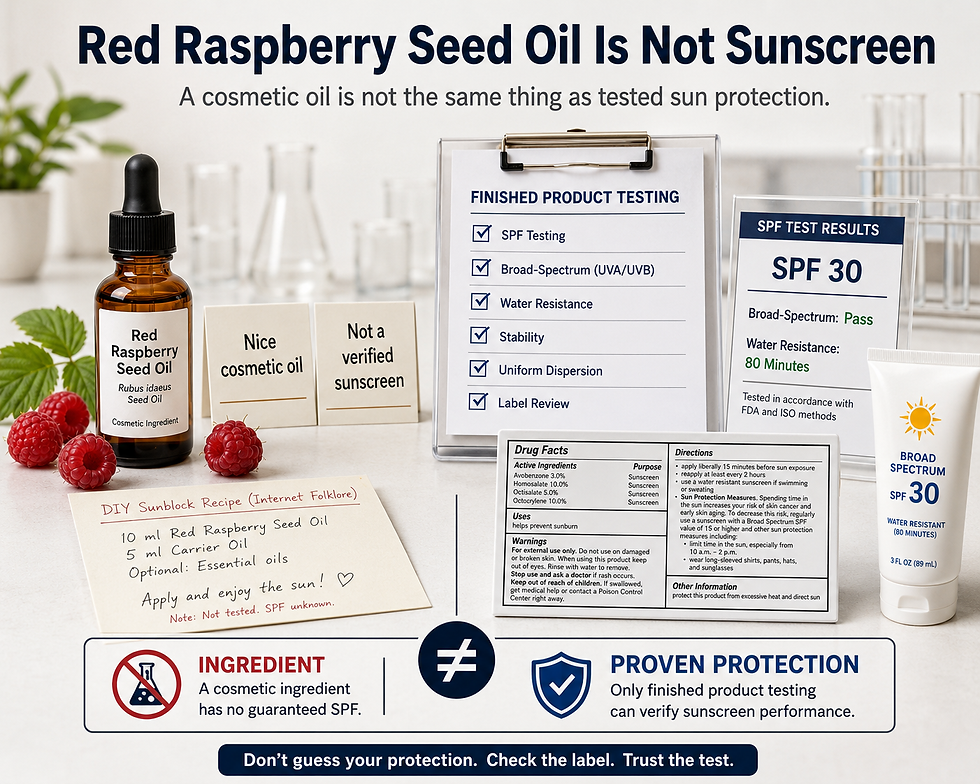
Red Raspberry Seed Oil Is Not Sunscreen
Red raspberry seed oil is one of the most repeated DIY sunscreen myths.
People claim it has “excellent SPF protection.” Some internet recipes claim it has an SPF similar to commercial sunscreen. This gets repeated so often that people assume it must be true.
But it is not reliable sunscreen protection.
A review on red raspberry seed oil notes that later testing found SPF values of about 0.4 in vitro and 2.6 in vivo, which is significantly lower than the values reported in earlier controversial studies.
That is nowhere near meaningful sunscreen protection.
Red raspberry seed oil may be a perfectly nice cosmetic oil. It may contribute emollience. It may contain antioxidant components. It may have a place in skincare.
But it is not a tested broad-spectrum sunscreen.
A nice oil is not the same thing as SPF 30.

Carrot Seed Oil Is Not Sunscreen Either
Carrot seed oil is another myth that refuses to die.
The claim usually goes something like this:
“Carrot seed oil has SPF 38–40.”
That claim has been repeated all over blogs, Pinterest, and natural skincare posts, but the evidence does not support using carrot seed oil as a standalone sunscreen.
A 2021 study evaluated the real UVB photoprotective efficacy of several vegetable oils because some oils are promoted as safe alternatives to commercial sunscreen. The study found that the real photoprotective efficacy of the tested oils was significantly lower than the values often claimed online.
That is the part that matters for makers.
An oil may show some UV absorbance in a lab method.
That does not mean it functions as a sunscreen on human skin.
It does not mean it gives broad-spectrum protection.
It does not mean it has been tested as a finished product.
It does not mean it can replace sunscreen.
Carrot seed oil is not your SPF system.
Coconut Oil, Shea Butter, Tallow, and Cocoa Powder Are Not Sunscreen Systems
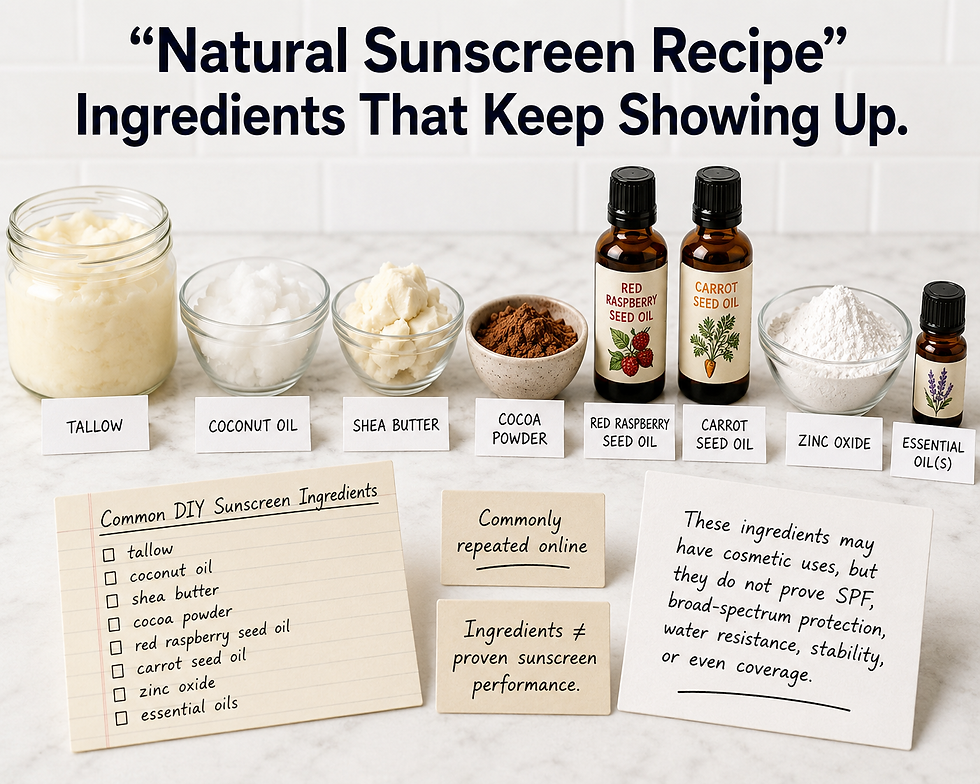
Let’s talk about the “natural sunscreen recipe” ingredients that keep showing up.
Tallow.
Coconut oil.
Shea butter.
Cocoa powder.
Essential oils.
Red raspberry seed oil.
Carrot seed oil.
These ingredients may have cosmetic uses. Some may be emollients. Some may add occlusion. Some may improve skin feel. Cocoa powder may tint a product and reduce the white cast from zinc oxide.
But none of that proves sunscreen performance.
Tallow is not a sunscreen active.
Coconut oil is not a reliable sunscreen.
Shea butter is not a tested SPF system.
Cocoa powder is not broad-spectrum protection.
Essential oils do not improve SPF.
And adding these ingredients to zinc oxide does not magically create a tested sunscreen.
This is where “natural” marketing gets people into trouble. Natural does not mean tested. Natural does not mean broad-spectrum. Natural does not mean stable. Natural does not mean protective.
A natural product can still fail.
And when a sunscreen fails, the consequence is not just a disappointing texture.
The consequence can be sunburn, UV damage, and increased skin cancer risk.

Tallow Is Not the Rescue Cure-All Answer
Tallow is having a major moment in the natural skincare world.
That does not make it sunscreen.
Tallow can be used as an anhydrous balm base. It can provide emollience and occlusion. Some people like the skin feel. Some people like the traditional aspect of it. Some people like using animal fats in handmade skincare.
Fine.
But tallow does not turn zinc oxide into a tested sunscreen.
Tallow does not prove SPF.
Tallow does not prove UVA protection.
Tallow does not prove broad-spectrum performance.
Tallow does not prove dispersion.
Tallow does not prove stability.
Tallow does not make a product legally compliant as an OTC sunscreen drug product.
The problem is not tallow itself. The problem is treating tallow like it magically solves every formulation, skin, barrier, inflammation, acne, aging, and sun-protection problem.
It does not.
A tallow balm can be a tallow balm.
It should not be presented as a verified sunscreen unless the finished product has gone through the appropriate formulation, testing, labeling, and regulatory requirements.

Essential Oils Do Not Belong in a DIY Sunscreen Recipe
I also saw essential oils being suggested in homemade sunscreen recipes.
This is another red flag.
Essential oils are not sunscreen filters. They do not prove SPF. They do not prove broad-spectrum protection. They do not make a sunscreen more protective.
Depending on the essential oil and the usage level, they may add irritation, sensitization potential, or phototoxicity concerns. Even when a specific essential oil is not considered phototoxic, that still does not make it useful in a sun-protection product.
A sunscreen product should be built around performance, safety, testing, and user compliance.
It should not be treated like a scented balm recipe.

“Sunscreen Causes Cancer” Is Not Evidence-Based
Another claim that came up was that sunscreen causes cancer and that people have been “duped.”
That is a serious claim, and serious claims require serious evidence.
The evidence does not support telling people to throw out sunscreen because it causes cancer.
The American Academy of Dermatology recommends using a broad-spectrum, water-resistant sunscreen with SPF 30 or higher as part of sun protection.
The CDC recommends sun-protection measures including shade, clothing, hats, sunglasses, and sunscreen.
Does that mean every sunscreen is perfect? No.
Does that mean every filter discussion is simple? No.
Does that mean every person likes the feel of every sunscreen? Absolutely not.
People may prefer mineral sunscreens. People may avoid certain filters because of sensitivity. People may choose fragrance-free products. People may choose different textures, brands, or formats.
That is all reasonable.
But “sunscreen causes cancer” is not the same thing as having a thoughtful discussion about sunscreen ingredient safety, irritation, regulations, or product preference.
One is a conversation.
The other is misinformation.
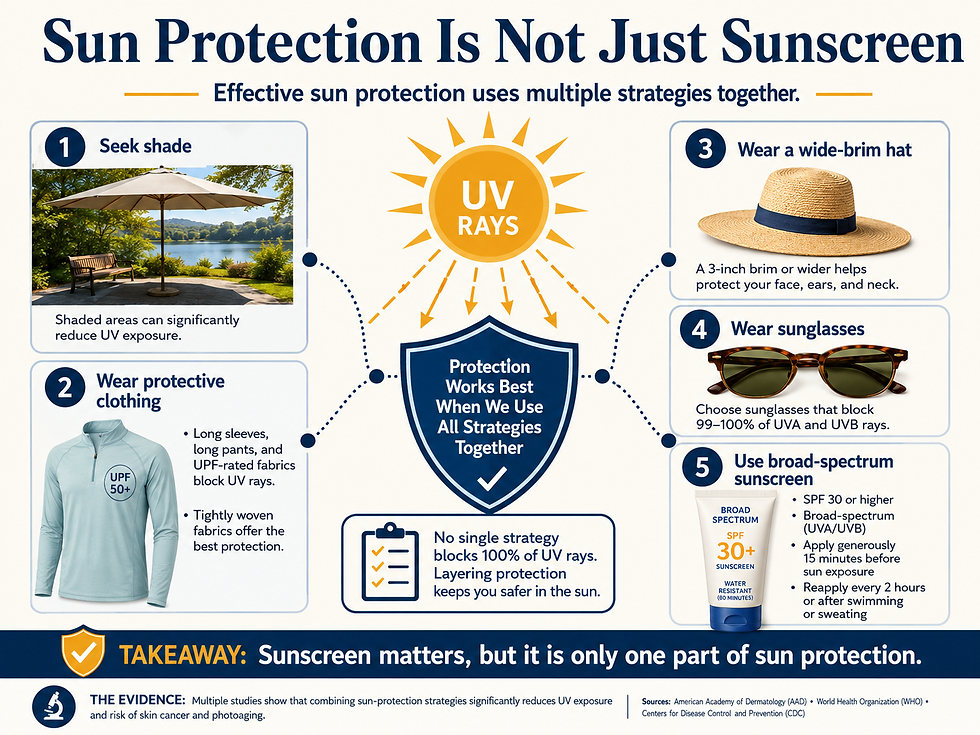
Sun Protection Is Not Just Sunscreen
This is another point that needs to be clear.
Being pro-sunscreen does not mean “slather yourself in sunscreen and bake outside all day.”
That is not the message.
Sun protection is broader than sunscreen.
The CDC recommends protecting yourself from UV exposure by using shade, clothing, hats, sunglasses, and sunscreen.
The AAD also recommends seeking shade and wearing sun-protective clothing, including long sleeves, pants, a wide-brimmed hat, and sunglasses, in addition to using broad-spectrum, water-resistant sunscreen with SPF 30 or higher.
That is the sane, evidence-based position.
Use multiple forms of protection.
Do not rely on one product to do everything.
Do not use sunscreen as permission to intentionally overexpose yourself.
And do not replace tested sunscreen with tallow balm because someone on Facebook said coconut butter is natural SPF.

Taking Off Sunglasses Does Not Tell Your Skin to Protect Itself
One of the more bizarre claims was that people should remove sunglasses because the eyes somehow respond to the sun and tell the skin to protect itself.
No.
That is not evidence-based sun protection advice.
The CDC includes sunglasses as part of sun safety and states that sunglasses protect the eyes from UV rays and reduce the risk of cataracts. Sunglasses that block both UVA and UVB rays offer the best protection.
Your eyes are not a sunscreen sensor.
Taking off sunglasses does not replace sunscreen, shade, clothing, or hats.
It just increases UV exposure to your eyes and the delicate skin around them.

Vitamin D Does Not Justify Unsafe Sun Exposure
Vitamin D is important.
That does not mean unprotected UV exposure is automatically safe.
You can support vitamin D without pretending sunscreen is the enemy.
This is where nuance matters. People can discuss vitamin D, diet, supplements, and responsible outdoor time without pretending that UV radiation is harmless or that sunscreen is a conspiracy.
The problem is not going outside.
The problem is using vitamin D as an excuse to dismiss UV damage, tanning, sunburn, and skin cancer risk.
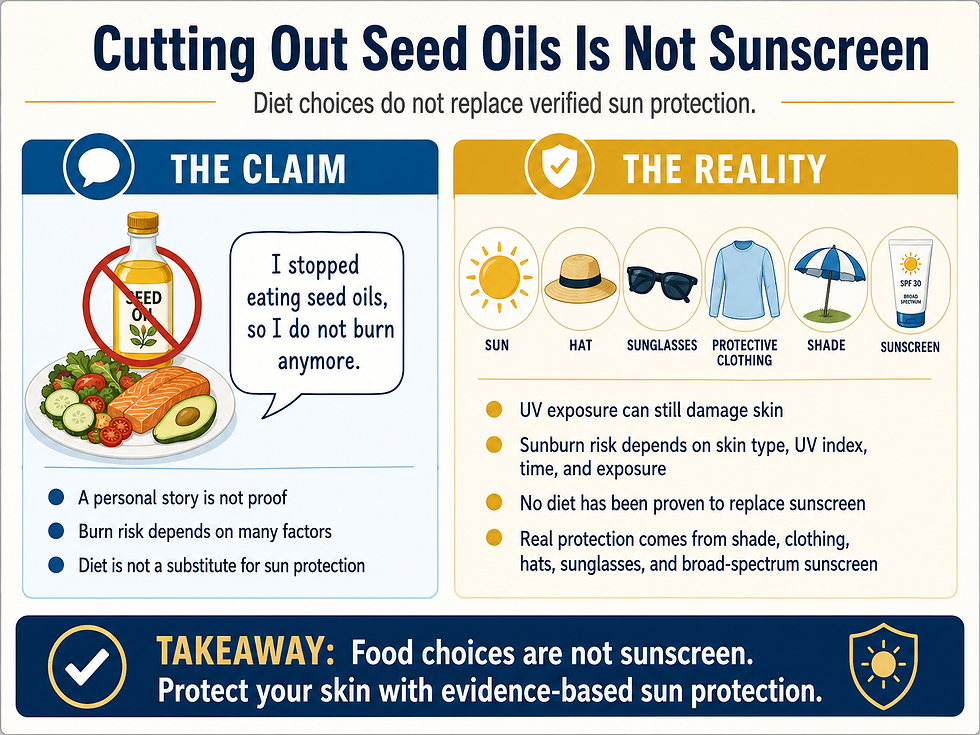
Cutting Out Seed Oils Is Not Sunscreen
Another claim was that cutting out seed oils made someone stop burning.
That may be someone’s personal experience, but it is not sunscreen science.
Anecdotes are not controlled evidence.
Whether someone burns depends on many factors, including skin type, UV index, time of day, season, altitude, latitude, cloud cover, reflective surfaces, medications, prior exposure, clothing, shade, and how long they were outside.
A person saying “I cut out seed oils and now I tan” does not prove diet replaces sun protection.
It does not prove sunscreen causes cancer.
It does not prove tallow is protective.
It does not prove UV radiation is harmless.
It proves someone had an experience and interpreted it through their existing belief system.
That is not how we formulate. That is not how we test. And that is not how we should educate people about sun protection.

“I Make It for Personal Use” Still Has a Risk
Some people will say, “Well, I only make it for personal use.”
That is your choice.
Adults can choose what they want to put on their own skin.
But there is still risk in making a product and believing it provides sunscreen protection when it has not been tested.
The biggest danger of DIY sunscreen is false confidence.
If someone knows they are wearing no sunscreen, they may seek shade, wear clothing, use a hat, or limit exposure.
But if someone believes their homemade tallow zinc balm is “natural sunscreen,” they may stay outside longer than they otherwise would. They may put it on their children. They may use it during peak UV hours. They may skip a properly tested sunscreen because they believe the homemade product is protecting them.
That is the danger.
An untested sunscreen does not just fail quietly.
It can change behavior.
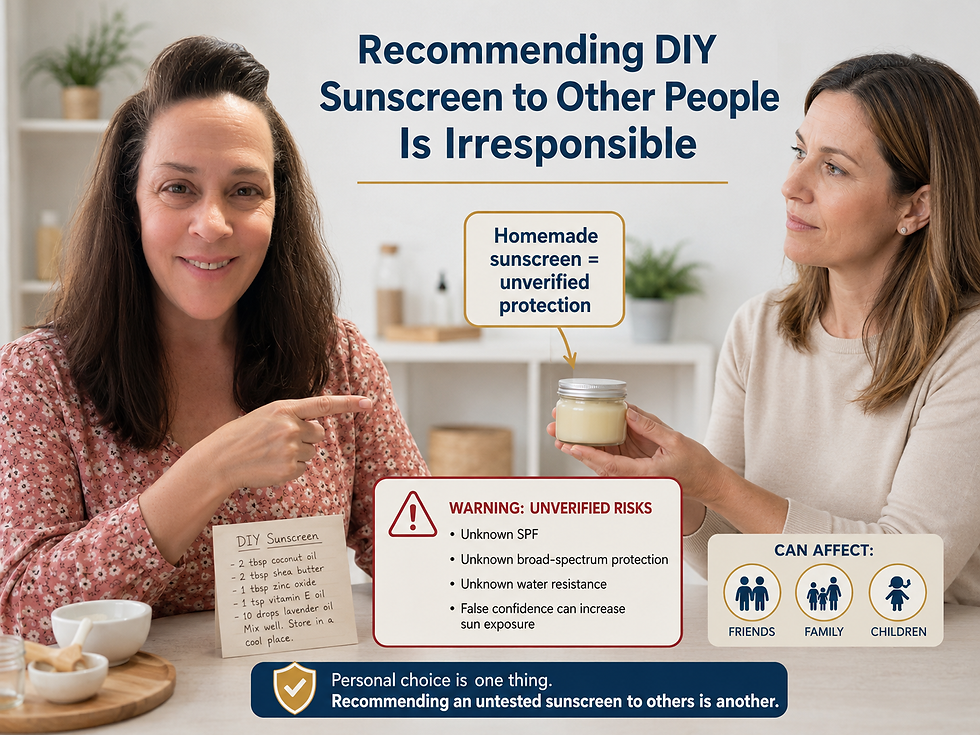
Recommending DIY Sunscreen to Other People Is Irresponsible
This is where I draw the hardest line.
Making something for yourself is one thing.
Recommending it to others is another.
When someone asks for a sunscreen recipe and the responses are “use tallow,” “add zinc oxide,” “use red raspberry seed oil,” “check Pinterest,” or “coconut butter is natural sunscreen,” that is not harmless community advice.
That is people giving sun-protection advice without proof of protection.
If you cannot prove the SPF, do not claim SPF.
If you cannot prove broad-spectrum protection, do not imply broad-spectrum protection.
If you cannot prove water resistance, do not suggest it for swimming or sweating.
If you cannot prove stability, do not tell people it works over time.
If you cannot prove zinc dispersion, do not assume the skin is evenly protected.
If you are not operating as a compliant OTC drug manufacturer, do not market or sell sunscreen.
And if you cannot prove the finished product works, do not tell someone else to use it as sunscreen.
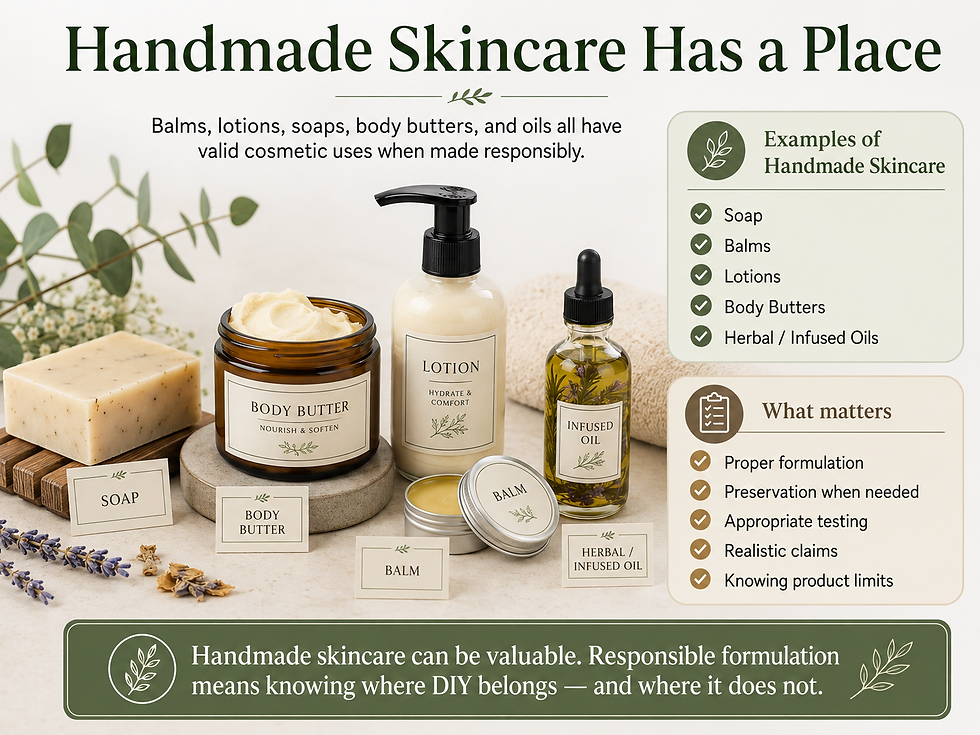
Handmade Skincare Has a Place
I want to be very clear about something.
This is not an attack on handmade skincare, like I said, it’s literally what I’ve been doing for over 24 years.
Handmade skincare has a place.
Goat milk soap has a place.
Herbal oils have a place.
Body butters have a place.
Balms and salves have a place.
But every product category has limits.
A tallow balm can be a balm.
A body butter can be a body butter.
A lotion can be a lotion.
A soap can be a soap.
But when you claim sun protection, you have crossed into a different category of responsibility.
That is where the DIY mindset needs to stop and real testing needs to begin.

The sun absolutely can contribute to skin cancer.
Sunscreen does not become dangerous just because someone calls it “chemicals.”
Natural oils do not become sunscreen because a blog repeated an inflated SPF number.
Zinc oxide does not guarantee protection unless the finished formula is properly made and tested.
And tallow is not a rescue cure-all answer to every skincare problem.
Make the balm.
Make the butter.
Make the soap.
Infuse the herbs.
Render the tallow.
Use the oils.
Enjoy handmade skincare.
But when it comes to sunscreen?
Buy a properly tested, broad-spectrum sunscreen and use it with other sun protection measures.
Because DIY sunscreen is where handmade skincare needs to stop.

Sources & Reference Material
CDC — Sun Safety Facts: UV exposure, skin cancer prevention, shade, clothing, hats, sunglasses, and sunscreen. https://www.cdc.gov/skin-cancer/sun-safety/index.html
American Cancer Society — UV radiation as a risk factor for skin cancer. https://www.cancer.org/cancer/risk-prevention/sun-and-uv/uv-radiation.html
FDA — Current requirements for marketing OTC sunscreen products under the deemed final order. https://www.fda.gov/drugs/understanding-over-counter-medicines/questions-and-answers-fda-posts-deemed-final-order-and-proposed-order-over-counter-sunscreen
FDA — Labeling and effectiveness testing for OTC sunscreen drug products, including SPF, broad-spectrum, water resistance, Drug Facts labeling, and drug listing. se
American Academy of Dermatology — Sunscreen FAQ and recommendation for broad-spectrum, water-resistant SPF 30 or higher. https://www.aad.org/media/stats-sunscreen
American Academy of Dermatology — Sun protection statement including shade, clothing, hats, sunglasses, and broad-spectrum sunscreen. https://www.aad.org/news/statement-importance-of-sun-protection
Red Raspberry Seed Oil Review — Later SPF testing values around 0.4 in vitro and 2.6 in vivo. https://pmc.ncbi.nlm.nih.gov/articles/PMC8151122/
~Lissa~


Comments