Azelaic Acid: What It Does, Why It Is So Difficult to Formulate, and What the Viral pH Controversy Actually Tells Us

Azelaic acid has become one of the most talked-about skincare ingredients of 2026—but not only because people are interested in what it may do for blemishes, redness and uneven-looking skin tone.
Right now, the real conversation is about the chemistry.
Two popular products—Anua’s Azelaic Acid 10 Hyaluron Redness Soothing Serum and Medicube’s Azelaic Acid 16 Calming Serum—have landed in the middle of a viral debate about pH, neutralization and whether azelaic acid still works after much of it has shifted into its ionized, or “salt,” form.

One side says that once the pH rises above azelaic acid’s dissociation range, the ingredient is basically useless.
The other side says that neutralized, solubilized azelaic acid is clearly better than the more traditional suspended form.
Neither conclusion is supported strongly enough to state as fact.
Azelaic acid is a genuinely useful dermatologic active. It is also a stubborn raw material with very poor water solubility, two ionizable acid groups and a performance profile that depends heavily on the entire formula—not just the percentage printed on the front of the bottle.
To understand what is really going on, we need to separate several questions that keep getting tangled together:
What exactly is azelaic acid?
What does the clinical evidence support?
Why is it so hard to dissolve?
What happens as the pH changes?
When should it be suspended instead of solubilized?
What do solvents and neutralizers contribute?
Can ionized azelaic acid still penetrate the skin?
What can we honestly conclude about the Anua and Medicube products?
These questions are connected, but they are not the same question.
What Is Azelaic Acid?
Azelaic acid—also called nonanedioic acid—is a straight-chain, nine-carbon saturated dicarboxylic acid. That simply means it has a carboxylic-acid group at each end of the molecule:
HOOC–(CH₂)₇–COOH
Azelaic acid occurs naturally in human biology and in some dietary sources, but the azelaic acid used in pharmaceutical and cosmetic manufacturing is a standardized industrial raw material. It is not being extracted directly from a handful of wheat, rye or barley and stirred into a skincare product.

The current U.S. prescribing information for Azelex describes azelaic acid as a naturally occurring saturated dicarboxylic acid. (dailymed.nlm.nih.gov)
In raw-material form, azelaic acid is a white crystalline solid.
The molecule itself is fairly simple. Getting a meaningful amount of it into a stable, comfortable and effective topical formula is where things become difficult.
The biggest problem is solubility.
Azelaic acid’s water solubility is reported at approximately 0.24 grams per 100 milliliters of water at 25°C, or roughly 0.24%. That is nowhere near enough to create a straightforward 10%, 15% or 20% water-based product. (pmc.ncbi.nlm.nih.gov)
To put that into practical terms, a 10% formula contains around 10 grams of azelaic acid in every 100 grams of finished product. Water alone can hold only a small fraction of that amount under ordinary conditions.
So the formulator has to make a decision.
Do we keep some or all of the azelaic acid as carefully controlled solid particles? Do we change the solvent system? Do we neutralize the acid? Or do we combine several of those approaches?
That decision shapes the entire formula.
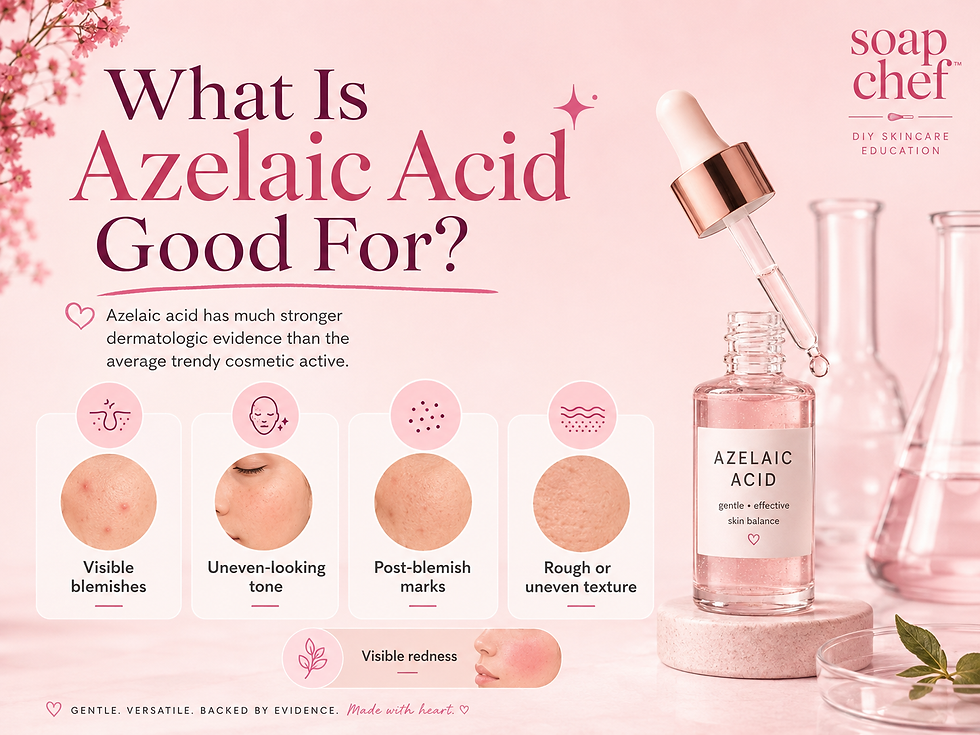
What Is Azelaic Acid Good For?
Azelaic acid has much stronger dermatologic evidence than the average trendy cosmetic active.
That does not mean every cosmetic serum containing azelaic acid automatically carries the same evidence as an approved drug product. We still have to separate research on prescription products from claims being made for ordinary cosmetics.
Acne
In the United States, Azelex 20% azelaic acid cream is indicated for the topical treatment of mild-to-moderate inflammatory acne vulgaris.
Its prescribing information also describes evidence of altered keratinization, including reduced stratum-corneum thickness and changes involving keratohyalin granules and filaggrin distribution after treatment. (dailymed.nlm.nih.gov)
The clinical rationale for using azelaic acid in acne includes several proposed or demonstrated actions:
Antimicrobial activity against organisms associated with acne
Effects on abnormal follicular keratinization
Anti-inflammatory activity
Reduction of inflammatory lesions
Azelaic acid has shown in-vitro antimicrobial activity against Cutibacterium acnes, which was previously called Propionibacterium acnes.
That activity is influenced by test conditions, including pH and nutrient environment. So while the antimicrobial evidence is relevant, an in-vitro result cannot simply be converted into a finished-product claim for any cosmetic serum containing azelaic acid. (academic.oup.com)
Papulopustular rosacea
Finacea 15% azelaic acid gel and foam are indicated for the inflammatory papules and pustules associated with mild-to-moderate rosacea.
The label is more specific—and more limited—than many social-media summaries make it sound.
Finacea’s efficacy for rosacea redness without papules and pustules has not been established.
In two randomized, double-blind, vehicle-controlled trials involving 664 participants, the 15% gel reduced inflammatory lesion counts more than the vehicle after 12 weeks. (dailymed.nlm.nih.gov)
Azelaic acid has also been shown in experimental and clinical research to affect the kallikrein-5 and cathelicidin inflammatory pathway associated with rosacea.
That is useful mechanistic evidence, but the FDA-approved labeling still states that the mechanism by which azelaic acid interferes with the pathogenic events of rosacea is not fully known.
In other words, we have meaningful evidence, but the entire mechanism is not settled science. (pubmed.ncbi.nlm.nih.gov)

Melasma and uneven pigmentation
Azelaic acid has also been studied for melasma and other hyperpigmentation concerns.
A 2023 systematic review and meta-analysis compared azelaic acid with hydroquinone for melasma. A broader systematic review also concluded that azelaic acid performed better than vehicle in studies involving acne, rosacea and melasma.
The concentrations, vehicles, study designs and overall quality of the evidence vary.
That matters because evidence for a 20% dermatologic cream cannot automatically be transferred to every 10% cosmetic serum that lists azelaic acid on the label. (pubmed.ncbi.nlm.nih.gov)
The pigment-related rationale is generally associated with inhibition of tyrosinase and effects on abnormal melanocyte activity.
That supports its dermatologic use and continued research, but a cosmetic company still has to substantiate the specific appearance claims made for its own finished product. (pmc.ncbi.nlm.nih.gov)

Dermatologic Evidence Is Not the Same as Cosmetic Claim Permission
This is an important distinction, especially for anyone selling products in the United States.
A product’s legal classification depends heavily on its intended use and the claims being made for it.
Claims that a product treats acne, rosacea or melasma are drug claims because they describe the treatment or mitigation of disease.
FDA does not recognize “cosmeceutical” as a separate legal category. A product is not granted a special middle ground just because the company uses that word in marketing. (fda.gov)
Azelaic acid is also not included among the active ingredients authorized under the current U.S. OTC acne monograph.
That monograph lists benzoyl peroxide, salicylic acid, sulfur and certain resorcinol combinations. It does not list azelaic acid. (accessdata.fda.gov)
A cosmetic containing azelaic acid may be marketed using properly substantiated appearance language, such as helping improve the appearance of:
Visible blemishes
Uneven-looking skin tone
Post-blemish marks
Rough-looking texture
Visible redness associated with cosmetic irritation
What it should not casually claim is that it treats acne, rosacea, melasma, inflammation or bacterial infection unless the product is being lawfully marketed as a drug.

Why Azelaic Acid Is Such a Difficult Raw Material
Azelaic acid looks simple on paper, but it is a pain to formulate well.
Several problems show up at the same time.
First, the neutral form is poorly soluble in water.
Second, azelaic acid is often used at fairly high concentrations. The pharmaceutical products that established its reputation generally contain 15% or 20%.
Third, it is crystalline.
That means a formula can look clear while it is hot, then become cloudy, gritty or visibly crystalline as it cools. It can also precipitate later because of evaporation, pH drift, temperature changes or slow crystal growth during storage.
Fourth, the product has to deliver a reasonably uniform amount of active every time it is used.
A suspension that settles, cakes, clumps or develops larger crystals is not successful just because the total batch still technically contains the claimed percentage of azelaic acid.
Finally, skin delivery depends on a balance among solubility, ionization, release from the vehicle and partitioning into the skin.
That is why “just add azelaic acid to a serum base” is not a real formulation strategy.

Azelaic Acid Has Two pKa Values
Because azelaic acid has two carboxylic-acid groups, it can lose two protons in stages.
One frequently cited study reports approximate pKa values of:
pKa₁: 4.53
pKa₂: 5.33
Other sources report slightly different values, but the underlying chemistry remains the same.
Azelaic acid does not suddenly flip from “acid” to “salt” when the formula crosses one magical pH number. The change happens gradually, and several forms can exist in the formula at the same time. (pmc.ncbi.nlm.nih.gov)
Using pKa values of 4.53 and 5.33, the theoretical species distribution in an ideal aqueous system is approximately:
pH | Neutral H₂Az | Monoionized HAz⁻ | Doubly ionized Az²⁻ |
4.0 | 76.4% | 22.5% | 1.1% |
4.5 | 48.3% | 45.1% | 6.7% |
4.9 | 23.7% | 55.6% | 20.7% |
5.5 | 4.1% | 38.7% | 57.2% |
5.9 | 0.9% | 21.0% | 78.1% |
These numbers are theoretical equilibrium estimates. They are not direct measurements of any commercial formula.
Temperature, concentration, ionic strength, cosolvents and the rest of the formulation can all affect how a real system behaves.
Still, the table makes two things very clear.
At pH 4.5, azelaic acid is not purely nonionized.
At pH 5.5, it is predominantly ionized, but more than one form is still present.
What Does “Salt Form” Actually Mean?
When sodium hydroxide is added to an aqueous azelaic-acid formula, it can neutralize one or both of the acid groups.
Depending on how much base is used and where the final equilibrium settles, the formula may contain:
Neutral azelaic acid
Monoazelate ions
Diazelate ions
Sodium counterions
Possibly some undissolved solid azelaic acid
This is reversible acid–base chemistry.
The azelaic-acid molecule has not been destroyed. It has not turned into a completely unrelated ingredient. Its carbon skeleton is still there.
Calling the system “sodium azelate” can be reasonable shorthand when sodium hydroxide is the neutralizer, but that wording can also make the system sound simpler than it really is.
It does not mean that every molecule in a complex finished formula exists as one fixed, fully neutralized salt.
A more accurate description would be that the formula contains predominantly ionized azelate species at the higher pH.
The ingredient list does not tell us the protonation state. It also does not tell us how much azelaic acid is dissolved, how far the neutralization has gone or whether some of the active remains suspended as solid material.
Some formulators deliberately develop azelaic-acid products within an acidic range of roughly pH 3.9 to 4.9. The reasoning is understandable: at the lower end, more azelaic acid remains in its neutral form, while moving closer to pH 4.9 increases ionization and may improve how much can be held in solution. That can create a useful middle ground between a heavily suspended low-pH product and a more extensively neutralized higher-pH serum.
But pH alone does not create that balance. In the frequently cited skin-delivery study, the pH 3.9 formula was a suspension, while the pH 4.9 formula was solubilized using a substantial cosolvent system. The improved delivery came from the interaction between pH and vehicle—not from the number 4.9 by itself.
It is also too broad to say that this pH range automatically minimizes irritation. Proper particle control, solvent choice, concentration, vehicle design and the user’s skin condition still matter. A well-designed formula in this range may provide good tolerability and delivery, but those outcomes have to be demonstrated in the finished product rather than assumed from pH alone

Formulation Route One: A Controlled Suspension
When the formula is acidic enough that a large portion of the azelaic acid remains in its poorly water-soluble neutral form, the formulator may choose to create a suspension.
That means the azelaic acid is present as carefully controlled solid particles dispersed throughout the product rather than fully dissolved.
A suspension is not automatically a failed or outdated formula.
A good suspension has to be engineered properly.
Particle size
Particle size can influence dissolution rate, stability, bioavailability and sensory feel.
FDA’s ICH Q6A guidance specifically identifies particle-size distribution as a potentially critical attribute for drugs used in suspension products. (fda.gov)
In the 2012 ionization study that has become central to the current viral debate, the suspended 10% azelaic-acid formula was made using material milled to approximately 5 micrometers.
That was not ordinary raw powder stirred into a gel and called finished.
It was a deliberately controlled experimental suspension. (pubmed.ncbi.nlm.nih.gov)
Wetting and deagglomeration
Dry crystalline powder has to be wetted and dispersed properly.
Poor wetting can leave air around the particles and encourage clumping. Incomplete deagglomeration can make a powder with a fine primary particle size behave as though the particles are much larger.
The wetting method has to be chosen based on compatibility, processing and stability data.
There is no universal rule saying that every azelaic-acid powder should be prewetted in the same liquid.
Rheology
The continuous phase has to provide enough structure to slow sedimentation and maintain reasonably uniform active distribution.
This is not simply a matter of making the product thick.
A suspension may depend on viscosity, yield stress, controlled particle interactions or controlled flocculation.
Pharmaceutical suspension development commonly looks at:
Particle size
Settling
Rheology
Zeta potential
Caking
Redispersibility
Long-term physical stability
A suspension has to be evaluated over time for:
Sedimentation
Caking
Redispersibility
Particle-size changes
Agglomeration
Crystal growth
Dose uniformity
Sensory changes
Package compatibility
Stability under relevant temperatures
A product can feel smooth on the day it is made and still become gritty weeks or months later because the particles agglomerate or the crystals grow.

Does Suspended Azelaic Acid Have to Feel Gritty?
No.
Suspended azelaic-acid products have a reputation for being thick, powdery or gritty because some products do feel that way.
But grittiness is not an unavoidable feature of suspension technology.
Noticeable grit may point to:
An excessively large particle-size distribution
Agglomeration
Poor powder wetting
Incomplete dispersion
Recrystallization
Crystal growth during storage
More solid material than the vehicle can comfortably carry
A properly engineered fine-particle suspension can be cosmetically acceptable.
It may still feel different from a clear or translucent serum in which the azelaic acid is more extensively solubilized, but “suspended” does not automatically mean “poorly formulated.”
Does Grit Cause the Burning?
Not necessarily.
Azelaic-acid drug labels document burning, stinging, itching, tingling, dryness and irritation.
Azelex labeling states that temporary irritation may occur partly because of the low pH, particularly when it is applied to broken or inflamed skin.
Its clinical-trial labeling reports pruritus, burning, stinging or tingling in approximately 1% to 5% of patients. (dailymed.nlm.nih.gov)
Finacea 15% gel also carries warnings about irritation and hypersensitivity.
That product uses a professionally developed aqueous gel vehicle containing propylene glycol, polyacrylic acid, lecithin, medium-chain triglycerides, polysorbate 80 and sodium hydroxide. (dailymed.nlm.nih.gov)
Large particles or rough agglomerates may contribute to mechanical discomfort, but stinging does not prove that the formula contains badly suspended particles.
The active concentration, pH, solvent system, applied amount, condition of the skin barrier and the individual user’s tolerance can all contribute.

Formulation Route Two: Neutralization
Another option is to raise the pH with a base.
As the pH rises, more of the azelaic acid shifts into ionized azelate species.
Those ionized forms are much more compatible with water than neutral azelaic acid.
A raw-material manufacturer specifically describes in-situ neutralization with sodium hydroxide as a route for producing more water-soluble mono- and disodium azelate species. (azelaic.com)
Neutralizers that appear in azelaic-acid research and commercial formulations include:
Sodium hydroxide
Potassium hydroxide
Tromethamine
Triethanolamine
That does not mean they can all be swapped freely.
The choice of counterion, final pH, ionic strength, polymer compatibility, sensory profile and regulatory status all matter.
Neutralizing azelaic acid is also not as simple as adding base until the powder disappears.
Azelaic acid is diprotic, so it has two potential neutralization equivalents.
The amount of base added affects how much has been neutralized. The pH gives useful information, but pH and degree of neutralization are not exactly the same thing.
The finished formula may also contain other acids, bases, buffers and salts that influence the measured pH.
The formulator needs to know:
The assay and purity of the azelaic acid
The concentration and strength of the base solution
The intended degree of neutralization
The target pH range
Whether the resulting electrolyte load is compatible with the thickener or emulsifier
Whether the product stays clear or begins to precipitate during storage
A batch looking clear while it is hot does not prove that it will remain a stable solution at room temperature.

Formulation Route Three: Cosolvents
A cosolvent changes the solvent environment so that more azelaic acid can stay dissolved than water alone would allow.
Depending on the formula, potentially useful solvent systems may include glycols, glycol ethers, short-chain alcohols and multifunctional diols.
The 2012 skin-delivery study used a very specific formula containing:
10% azelaic acid
25% 1,2-hexanediol
4% niacinamide
A cellulose-based rheology modifier
Triethanolamine for pH adjustment
The pH 4.9 experimental formula was solubilized. The pH 3.9 formula remained a suspension.
That study does not establish that 25% 1,2-hexanediol is appropriate for an ordinary commercial cosmetic.
What it does show is how strongly the vehicle and pH can work together to influence the physical state and skin delivery of azelaic acid. (pubmed.ncbi.nlm.nih.gov)
A cosolvent can help dissolve some neutral azelaic acid without complete neutralization.
Neutralization and cosolvency can also be used together.
So the formulation choice is not simply:
Low pH means suspension.High pH means solution.
The actual physical state of the azelaic acid depends on:
Azelaic-acid concentration
pH
Degree of neutralization
Solvent composition
Water content
Temperature
Process order
Mixing
Ionic strength
Other ingredients
Storage conditions

Suspension and Solution Can Exist at the Same pH
Finacea is a good example of why pH cannot tell us the whole story.
Published descriptions place Finacea gel around pH 4.8 to 4.9 and describe the azelaic acid as suspended in the vehicle.
The 2012 experimental formula at pH 4.9, however, solubilized 10% azelaic acid using a high concentration of 1,2-hexanediol and triethanolamine. (accessdata.fda.gov)
So we can have two products at roughly the same pH while the azelaic acid exists in very different physical states.
Concentration and vehicle architecture matter.
That is why a pH reading cannot tell us, by itself, whether the azelaic acid is fully dissolved, partly dissolved or mostly suspended.
Other Delivery Approaches
Researchers have also explored more advanced ways of working with azelaic acid, including:
Microemulsions
Liposomes and ethosomes
Nanocrystal and nanosuspension systems
Hydrogels
Deep-eutectic solvent systems
Other structured delivery vehicles
The goal is generally to improve one or more of the following:
Solubility
Release
Stability
Skin deposition
Sensory feel
Some of these systems have produced encouraging in-vitro or animal data.
That does not automatically prove that they are clinically superior in humans. (pmc.ncbi.nlm.nih.gov)
These technologies also have to be properly developed and characterized.
Calling an ordinary glycol serum an “advanced delivery system” does not replace particle analysis, release testing, stability data or skin-delivery studies.
Does Ionized Azelaic Acid Penetrate the Skin?
Yes. Ionized azelaic acid can cross the skin.
That does not mean molecular charge suddenly stops mattering.
Neutral molecules generally partition into the lipid-rich stratum corneum more easily than strongly charged molecules.
At the same time, a poorly soluble neutral molecule cannot move efficiently from the formula into the skin if very little of it is actually available in solution.
That gives us a familiar formulation tradeoff:
The neutral form generally has a partitioning advantage.
The ionized form has a solubility advantage.
The vehicle determines how much of each form is available at the skin surface.
Dissolution and release may become the limiting steps.
So we cannot look at ionization alone and predict the final delivery result.

What the 2012 Skin-Delivery Study Actually Found
This is the study being cited over and over in the current controversy.
The researchers compared two 10% azelaic-acid formulas:
A pH 3.9 suspension
A pH 4.9 solubilized formula
The pH 4.9 formula produced greater azelaic-acid retention in the epidermis, dermis and total skin.
The calculated flux assigned to ionized azelaic-acid species was approximately:
27.7 µg/cm²/hour from the pH 3.9 formula
128.4 µg/cm²/hour from the pH 4.9 formula
That is approximately a fivefold difference in the calculated ionized-species flux.
It is not a fivefold difference in total azelaic-acid flux.
The full paper reports total flux values of approximately 154.1 and 187.2 µg/cm²/hour, respectively. That works out to a difference of about 21%. (pubmed.ncbi.nlm.nih.gov)
The researchers concluded that skin penetration depended strongly on both pH and vehicle and that solubilization was the rate-limiting step in that experimental system. (pubmed.ncbi.nlm.nih.gov)
That finding matters.
It tells us that the claim—
Ionized azelaic acid cannot penetrate the skin.
—is wrong.
What the study does not prove is that:
Every higher-pH azelaic-acid formula works
pH 5.9 is the ideal pH
A formula at pH 5.9 behaves like the tested formula at pH 4.9
Anua or Medicube has superior clinical efficacy
Solubilized azelaic acid is always better than suspended azelaic acid
A cosmetic serum performs like an approved drug
Results from mouse-skin diffusion automatically predict human treatment outcomes
The study measured skin transport under a very specific set of in-vitro conditions.
It did not measure acne improvement, rosacea improvement, pigment change or consumer results.

The Viral Anua and Medicube Controversy
The current online debate focuses mainly on:
Anua Azelaic Acid 10 Hyaluron Redness Soothing Serum
Medicube Azelaic Acid 16 Calming Serum
Anua’s official U.S. product page states that the serum contains 10% azelaic acid.
Its ingredient list begins with water, azelaic acid, propylene glycol, sodium hydroxide, dipropylene glycol and 1,2-hexanediol. (anua.com)
Medicube’s official U.S. page calls its product Azelaic Acid 16 Calming Serum and describes a high concentration of an “Azelaic Acid Complex.”
Its ingredient list begins with water, azelaic acid, butylene glycol, propanediol, sodium hydroxide, propylene glycol and Alcohol Denat. (medicube.us)
Sodium hydroxide appears near the beginning of both ingredient lists.
That is consistent with a meaningful degree of neutralization.
The multiple glycols—and Alcohol Denat. in the Medicube formula—are also consistent with a solvent-rich vehicle.
That is formulation logic based on the ingredient lists.
The lists do not tell us the exact percentage or technical function of each ingredient.
Are the Products Really Above pH 5.5?
This is where we have to be careful.
The Doctorly video that helped bring the controversy into the mainstream describes the Anua serum as having a pH around 5.9 and discusses both Anua and Medicube as higher-pH, solubilized azelaic-acid products.
As of August 2, 2026, I did not find an official finished-product pH published on the current U.S. product page for either Anua or Medicube. (anua.com)
That means:
The reported pH may be correct.
The ingredient lists make substantial neutralization chemically plausible.
The exact pH should still be described as a third-party measurement rather than a manufacturer-confirmed specification.
One social-media pH test is not the same thing as a validated laboratory report.
A properly documented investigation would tell us:
Which product batch was tested
How the sample was handled
What meter and electrode were used
Which calibration buffers were used
When the meter was calibrated
The temperature of the sample
Whether the product was measured directly or diluted
How many measurements were taken
Whether the reading was stable
Whether more than one batch gave similar results
Without that information, we should not treat a viral pH reading like an official product specification.
Are These Products “Fake” Because the Acid Is Ionized?
No.
Ionized azelaic acid is still part of the same reversible acid–base system.
The ingredient has not disappeared.
The 2012 diffusion study also shows that ionized species can contribute meaningfully to skin flux. (pubmed.ncbi.nlm.nih.gov)
The claim that these products contain “no real azelaic acid” simply because the formula has been neutralized is chemically incorrect.
That does not prove that either product is clinically effective.
The evidence supports a narrower conclusion:
A higher pH and substantial ionization do not automatically make an azelaic-acid formula fraudulent or inactive.
Does the 2012 Study Validate Anua and Medicube?
No.
The study used:
10% azelaic acid
pH 3.9 and 4.9
A high concentration of 1,2-hexanediol
Triethanolamine
Hairless mouse skin
Franz diffusion cells
In-vitro transport measurements
It did not test:
Anua
Medicube
pH 5.9
The actual solvent ratios used by either company
Finished-product stability
The dissolved fraction of azelaic acid in either serum
Human skin deposition
Acne outcomes
Rosacea outcomes
Pigmentation outcomes
So using that study to declare these commercial products “definitively effective,” “better than prescription products” or “the best form of azelaic acid” would go beyond the evidence.
Does the Skin Automatically Bring a pH 5.9 Formula to the Perfect pH?
That has not been established.
The skin surface is mildly acidic.
An applied product will interact with the skin, sweat, sebum, carbon dioxide, evaporation and any other products already on the surface.
The acid–base equilibrium can shift as those conditions change.
But that does not mean every formula at pH 5.9 automatically settles into one perfect or ideal pH after application.
The final pH of the film depends on:
Buffer capacity
Neutralizer concentration
Film thickness
Water evaporation
Applied dose
Other acids and bases in the formula
Skin condition
Contact time
Products applied underneath or on top
A visible white residue in an informal arm demonstration could simply represent concentration and crystallization as water or solvent evaporates.
Without analytical testing, it cannot tell us exactly which azelaic-acid species formed, how much entered the skin or whether the biological activity increased.
The Doctorly arm demonstration is useful as an illustration.
It is not a penetration study.

The Propylene Glycol Complaint
Anua contains propylene glycol.
Medicube contains propylene glycol along with several other glycols.
Propylene glycol is a recognized irritant and weak contact sensitizer.
It can produce both irritant and allergic patch-test reactions, which makes prevalence difficult to interpret.
A systematic review describes it as both a weak sensitizer and an irritant. (pubmed.ncbi.nlm.nih.gov)
Reported positive patch-test rates depend on the concentration used and the population being tested.
In a Mayo Clinic review involving 11,738 patch-tested patients, 0.85% had a positive reaction and 0.35% had an irritant reaction.
Another review concluded that propylene glycol is an uncommon cause of allergic contact dermatitis in people without underlying or predisposing skin conditions. (pubmed.ncbi.nlm.nih.gov)
Those figures came from dermatology patients who were being patch tested. They do not represent a random sample of the general population.
The most defensible description is:
Propylene glycol is a recognized potential irritant and weak contact allergen that may be unsuitable for some users.
Calling it a “common allergen” without qualification overstates the evidence.
Its presence also does not automatically make a formula poor.
Propylene glycol is used in the FDA-approved Azelex cream and Finacea gel vehicles. (accessdata.fda.gov)
The Alcohol Denat. Complaint
Medicube lists Alcohol Denat.
That means denatured ethanol.
It is not accurately described as “pure alcohol.”
Ethanol can act as a solvent. It can also influence how quickly a product dries, how the formula feels and how other ingredients move through the skin.
Depending on the concentration, frequency of use and condition of the user’s skin, it may also contribute to dryness, stinging or irritation.
Allergic sensitization to ethanol is possible, but that is not generally the main concern for most users. (pmc.ncbi.nlm.nih.gov)
The ingredient list does not tell us the exact concentration of Alcohol Denat.
It also does not prove that ethanol is solely responsible for dissolving the azelaic acid.
A reasonable criticism would be:
A solvent-rich formula containing Alcohol Denat. may be less comfortable for some people with compromised or reactive skin.
An unreasonable conclusion would be:
The presence of alcohol proves that the formula is harmful or badly made.
What a pH Reading and Ingredient List Cannot Tell Us
A pH reading and an ingredient declaration can give us useful clues.
They cannot give us the entire formula.
They cannot tell us:
The exact degree of neutralization
The free-versus-ionized azelaic-acid distribution in the complete formula
The total dissolved concentration
Whether any solid azelaic acid remains suspended
The crystal size
Thermodynamic activity
How easily the active releases from the vehicle
How it partitions into the skin
How much remains in the epidermis or dermis
Whether the product remains stable throughout its shelf life
What happens after application and solvent evaporation
Whether the product is clinically effective
Whether an individual user will tolerate it
Those questions require actual analytical, physical, stability, skin-delivery or clinical data.
What Evidence Would Resolve the Controversy?
To evaluate a finished azelaic-acid serum properly, we would need much more than a pH strip and an ingredient list.
Useful evidence would include:
1. Validated finished-product pH data
The pH should be tested under controlled conditions and, ideally, across more than one batch.
2. Azelaic-acid assay
A validated analytical method should confirm the total concentration of azelaic acid in the product.
3. Dissolved-versus-suspended fraction
Testing should distinguish azelaic acid that is truly in solution from azelaic acid present as dispersed crystals.
4. Particle-size analysis
If solid material is present, the particle-size distribution matters.
5. Stability testing
The product should be monitored for:
pH
Assay
Appearance
Precipitation
Crystal growth
Package compatibility
6. Release testing
Testing should show whether and how azelaic acid leaves the vehicle under relevant conditions.
7. Skin-deposition or permeation testing
Validated human-skin methods would be more informative than assumptions based on pH alone.
8. Finished-product clinical testing
The actual product should be tested using endpoints that match the claims being made.
Without that level of evidence, both sides of the controversy are trying to pull more certainty from the pH number than the pH number can provide.
Practical Formulation Takeaways
For formulators, the lesson is not that azelaic acid must always be kept below pH 4.5.
It is also not that it should always be pushed above pH 5.5.
The real lesson is that azelaic acid needs a deliberate physical and chemical strategy.
When developing a suspension
Start with a raw material whose particle-size distribution is known.
Establish an appropriate wetting and dispersion process.
Confirm that agglomerates have been broken down.
Build the rheology around particle support and redispersibility—not thickness alone.
Monitor settling, caking, crystal growth and dose uniformity.
Do not assume that a smooth fresh batch will remain smooth through its full shelf life.
When developing a neutralized system
Calculate and control the amount of base.
Remember that pH and degree of neutralization are connected, but they are not identical measurements.
Check whether the electrolyte load is compatible with the thickener or emulsifier.
Confirm that the formula remains stable after cooling and during storage.
Do not assume that a visually clear formula is completely or permanently solubilized.
When using cosolvents
Use real solubility and stability data for the chosen solvent system.
Evaluate irritation and sensitization based on concentration and the finished formula—not on the ingredient name alone.
Consider what may happen as the solvent evaporates from the film on the skin.
Test for delayed precipitation and crystal growth.
Do not assign a solvent’s exact role solely from its position on the ingredient list.
In every case
Measure rather than assume.
Test the finished product rather than relying only on ingredient-level literature.
Treat percentage, pH and INCI as parts of the formulation—not proof of delivery or efficacy.

The Bottom Line
Azelaic acid is a well-supported dermatologic active.
It has established prescription uses for inflammatory acne and papulopustular rosacea, along with evidence supporting its use in melasma and uneven pigmentation.
It is also one of the more difficult skincare ingredients to formulate properly.
The neutral form has very poor water solubility.
Raising the pH increases ionization and water compatibility, but it also changes how the molecule partitions and moves through the skin.
A controlled suspension, a neutralized aqueous system, a cosolvent-rich vehicle or a more advanced delivery system may all be valid approaches when they are properly developed and tested.
The current Anua and Medicube controversy gets one thing right:
The form in which azelaic acid exists matters.
Where the controversy goes wrong is when that fact gets turned into one oversimplified verdict.
A product is not automatically ineffective because most of its azelaic acid is ionized.
It is not automatically effective because the azelaic acid is solubilized.
And it is not clinically validated because one in-vitro mouse-skin study found better delivery from a different formula at pH 4.9 than from a suspension at pH 3.9.
The honest conclusion is not as dramatic, but it is much more useful:
Azelaic acid’s performance cannot be judged by percentage or pH alone. Its physical state, degree of neutralization, vehicle, release, stability, skin delivery and finished-product evidence all matter.
That is not a defense of Anua or Medicube.
It is not a condemnation of either company.
It is simply where the evidence stops.
~Lissa~

Sources & Reference Materials
U.S. Food and Drug Administration. Azelex 20% Azelaic Acid Cream Prescribing Information. Identity, acne indication, keratinization findings, absorption and adverse reactions. (dailymed.nlm.nih.gov)
U.S. National Library of Medicine, DailyMed. Finacea 15% Azelaic Acid Gel Prescribing Information. Rosacea indication, limitations, clinical trials, formulation and warnings. (dailymed.nlm.nih.gov)
Li N, Wu X, Jia W, et al. Effect of Ionization and Vehicle on Skin Absorption and Penetration of Azelaic Acid. Drug Development and Industrial Pharmacy. 2012;38(8):985–994. (pubmed.ncbi.nlm.nih.gov)
Feng X, et al. Azelaic Acid: Mechanisms of Action and Clinical Applications. Clinical, Cosmetic and Investigational Dermatology. 2024. (pmc.ncbi.nlm.nih.gov)
Sauer N, et al. The Multiple Uses of Azelaic Acid in Dermatology. 2024. (pmc.ncbi.nlm.nih.gov)
King S, et al. A Systematic Review to Evaluate the Efficacy of Azelaic Acid in the Treatment of Acne, Rosacea, Melasma and Skin Aging. 2023. (pubmed.ncbi.nlm.nih.gov)
Albzea W, et al. Azelaic Acid Versus Hydroquinone for Managing Patients With Melasma: Systematic Review and Meta-analysis. 2023. (pubmed.ncbi.nlm.nih.gov)
Coda AB, et al. Cathelicidin, Kallikrein 5 and Serine Protease Activity Is Inhibited During Treatment of Rosacea With Azelaic Acid 15% Gel. 2013. (pubmed.ncbi.nlm.nih.gov)
Bojar RA, et al. The In-vitro Antimicrobial Effects of Azelaic Acid upon Propionibacterium acnes. 1991. (academic.oup.com)
U.S. Food and Drug Administration. Is It a Cosmetic, a Drug, or Both? Cosmetic-versus-drug classification and intended-use principles. (fda.gov)
U.S. Food and Drug Administration. OTC Monograph M006: Topical Acne Drug Products for OTC Human Use. (accessdata.fda.gov)
U.S. Food and Drug Administration/ICH. Q6A Specifications: Test Procedures and Acceptance Criteria for New Drug Substances and New Drug Products. Particle-size and stability considerations. (fda.gov)
McGowan MA, et al. Propylene Glycol in Contact Dermatitis: A Systematic Review. 2018. (pubmed.ncbi.nlm.nih.gov)
Pemberton MA, et al. Propylene Glycol, Skin Sensitisation and Allergic Contact Dermatitis. 2023. (pubmed.ncbi.nlm.nih.gov)
Cosmetic Ingredient Review. Final Report on the Safety Assessment of Alcohol Denat. (accessdata.fda.gov)
Anua US. Azelaic Acid 10 Hyaluron Redness Soothing Serum—Official Product and Ingredient Information. Accessed August 2, 2026. (anua.com)
Medicube US. Azelaic Acid 16 Calming Serum—Official Product and Ingredient Information. Accessed August 2, 2026. (medicube.us)
Doctorly. The Truth About Azelaic Acid—Video Transcript Supplied for Review. Used only to document the current public controversy and the claims being evaluated.


Hi and thank you for such a complete answer. The conclusion is that it is not that simple... You focused on the chemestry here but I wonder what you think about the fact that this product has been marketed better than other "similar" 10% azealic acid serums because of its rexture without disclosing that the texture is more elegant because they have a different way of doing things. I understand reading the article that each product is different and only drug products have clear claims. But if you're using a different technique further away from the drugs which could work but you're not sure is it fair to make sunsch comparison with other 10% azelaic acid?
Also since it does…