Beyond the Ingredient List: What Makes a Well-Designed Moisturizer?
When you look at a moisturizer formula, what catches your attention first?
The shea butter? The silky emollients? The ceramides?
Those ingredients may have good reasons for being there. But when I look at a formula, I want to know more than what it contains. Why were those ingredients chosen, how are they being used, and what can I reasonably expect from the finished product?
That’s where I want to take October’s discussion of emollients, occlusives and barrier lipids. Once you understand their jobs, the next step is learning how to put that information to work without expecting an ingredient list to tell you everything.
What are you asking this moisturizer to do?
Before I start choosing ingredients, I want a clear picture of the product I’m making.
Is it a body product for use after a shower? Something for dry-feeling feet? A cream someone will apply before getting dressed?
Then I think about the experience. Should it spread easily over a large area? Leave a noticeable protective feel? Have a lighter finish?
These are questions I would put into the product brief. They help me decide what to include and what to pay attention to when I make the batch.
The American Academy of Dermatology also considers skin type and the severity of dryness when discussing moisturizer selection. That’s useful context: the intended user and skin need belong in the conversation from the beginning.

For my own development work, I would also ask whether the finish suits the intended routine. If I’m making a daytime body product, I want to assess how it feels under clothing. If I’m making a richer evening product, I may choose a different target.
That is a formulation decision. Whether other people find the finish comfortable enough for regular use is something I would need to ask them.
Give the ingredients a job
Emollients help keep skin feeling soft and smooth. That’s a useful starting point, but it still leaves plenty of decisions for the formulator.
For example, I might choose an emollient blend with easy spreading and a silky finish in mind. Then I need to make the product and see how the whole formula feels. Choosing ingredients for a sensory target is part of development; reaching that target is something I have to evaluate.
Occlusives bring water loss into the discussion. Petrolatum is a familiar example, although its behavior is more interesting than the usual description of something that simply sits on top of the skin. In a human study involving experimentally disrupted skin, researchers found petrolatum throughout the spaces between cells in the stratum corneum. It allowed barrier recovery rather than behaving like a completely impermeable surface covering.
Barrier lipids bring another set of questions. Research has investigated mixtures of ceramides, cholesterol and free fatty acids for their effects on barrier recovery. But the composition of those mixtures matters—and so do the conditions under which they were tested.

So when I look at these ingredients, I’m asking what each one contributes to the product I’m trying to make. I also want to know where my expectations come from: an ingredient’s documented properties, published research, or something I still need to check in my own formula.
Ceramides deserve more than a spot on the ingredient list
Ceramides are a good example of why I ask those questions.
It’s easy to see “ceramide” in a formula and think, “Good—that takes care of barrier support.”
I would slow down there.
A 1996 study looked at different proportions of ceramides, cholesterol and free fatty acids, primarily in experimentally disrupted mouse skin, with preliminary human findings. Changing the mixture affected the rate of barrier recovery.
A later study examined older skin after tape stripping. A cholesterol-dominant mixture accelerated recovery under the reported conditions. However, the human portion involved six participants, and the lipids were delivered in a specific solvent mixture. That is a very different setting from someone applying an everyday body cream.
These studies give formulators a reason to pay attention to lipid composition.
They don’t prove that every cream containing ceramides will produce the same result.
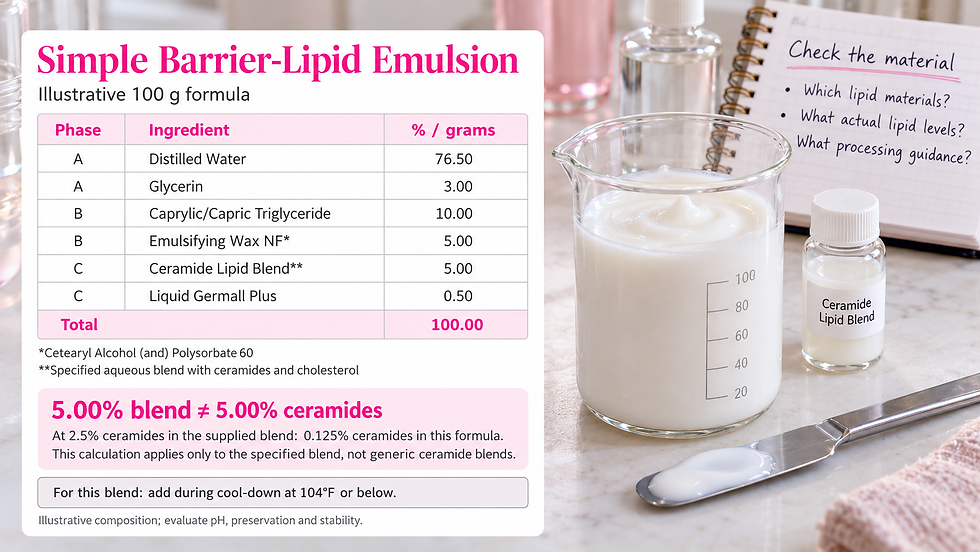
There’s a practical detail worth keeping straight, too. The research discusses molar ratios: proportions based on the number of molecules. A formula written in percentages by weight is using a different basis. You cannot copy the same numbers into your percentage column and assume you have reproduced the research mixture.
When I’m working with a ceramide ingredient, I want to know exactly what I have. Is it a defined material or a blend? How much actual ceramide does the supplied ingredient contain? What does the technical documentation say about incorporating it?

Those questions need answers before I can write a sound procedure or explain why I chose a particular level.
Think about two different body products
Let’s put this into a practical example.
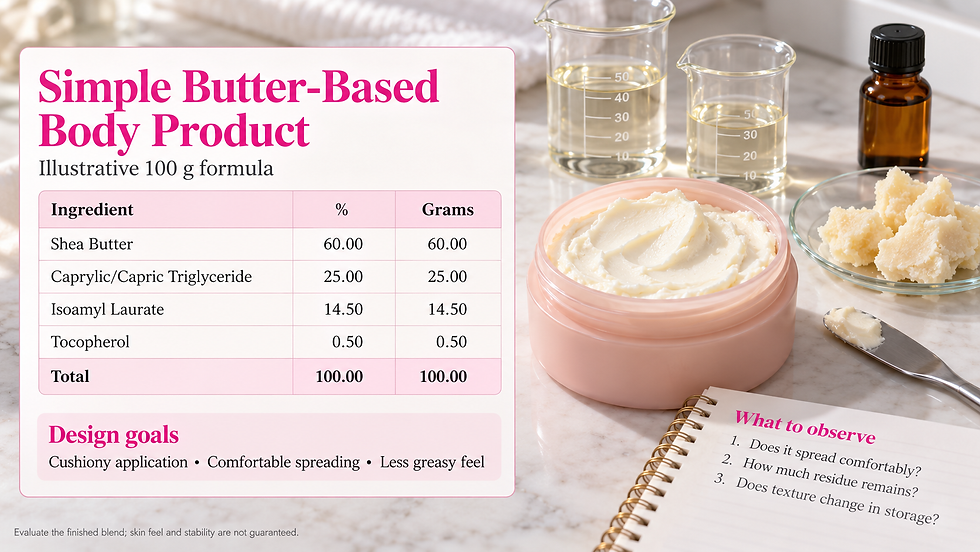
For a butter-based body product, my brief might focus on a cushiony application, comfortable spreading and a finish that doesn’t feel excessively greasy to the intended user.
I would choose the blend for those goals, make the batch and record what I observe. Does it spread the way I intended? How much residue do I feel? Does the texture change during storage?
For a barrier-lipid emulsion, I would have those same practical questions, plus a more detailed ingredient rationale. Which lipid materials am I using? At what actual levels? What processing instructions apply to those materials?
These are two different development briefs. Neither one establishes that its product is automatically better.
If I want to compare their hydration performance, I need relevant performance evidence. The presence of butter in one and ceramides in the other cannot settle that comparison.
A beautiful batch is encouraging—but keep checking
You know the satisfaction of making a batch that looks and feels exactly the way you hoped.
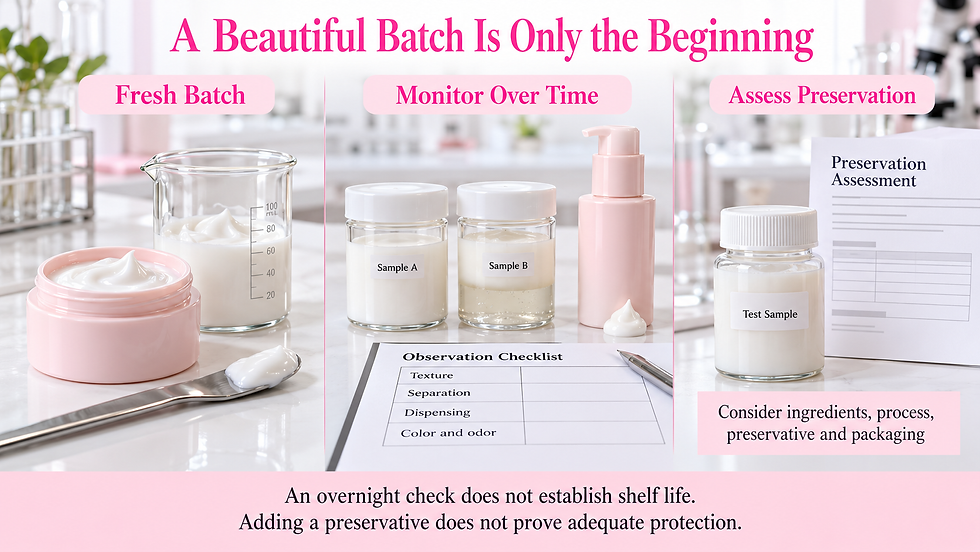
But, that's not the whole story. Keep watching it. Does the texture remain consistent? Does the emulsion separate? Does the product still dispense properly?
FDA explains that cosmetic shelf life depends on the product, how it is used and how it is stored. Its guidance discusses changes such as emulsion separation and changes in texture, color and odor. An overnight check gives me information about that point in time; it doesn’t establish the product’s full shelf life.
Preservation is another part of the picture. FDA identifies ineffective preservation, contaminated ingredients, poor manufacturing conditions and inadequate packaging among the ways cosmetics can become contaminated.
For a water-containing moisturizer, I need to consider that whole system. Adding a preservative is a formulation step. Evaluating whether the product is adequately protected is a separate task.
Say what you observed—and what you measured
I can use a cream and say, “My skin feels softer after applying it.”
That is a personal observation. It’s useful, and I can describe it honestly.
If I say the cream increases skin hydration by a particular amount, reduces water loss or provides a benefit for a stated number of hours, I’m making a more specific statement. I need evidence that answers that specific question.
Hydration measurements and measurements of transepidermal water loss—usually shortened to TEWL—answer different questions. Hydration concerns water content in the stratum corneum. TEWL concerns water passing outward through the skin, excluding perspiration. Published measurement guidance also explains why factors such as room conditions, body site and prior product use need to be considered.
You don’t have to own that equipment to make useful development notes. You can record spreading, residue, dispensing and changes during storage. Just keep the description connected to what you actually evaluated.
“Feels silky on application” and “increases skin hydration for 24 hours” require different kinds of support.
What I want to know about a moisturizer
When I look at a moisturizer formula, I want to be able to explain the choices.
Why this emollient blend? Why this occlusive? Why these barrier lipids? Why this process?
Then I want to look at the finished product and ask whether it meets the goals I set—and which questions still need evidence.
That’s what makes this month’s topic useful at the bench. Understanding emollients, occlusives and barrier lipids helps me make more deliberate choices.
Evaluating the finished formula tells me how those choices worked out.

The ingredient list gives me a place to start. The formulation work and the evidence give me something I can explain with confidence.
Sources & Reference Materials
1. American Academy of Dermatology. How to pick the right moisturizer for your skin. Used for general moisturizer-selection guidance and the softening and smoothing role of emollients.
2. Ghadially R, Halkier-Sorensen L, Elias PM. Effects of petrolatum on stratum corneum structure and function. Journal of the American Academy of Dermatology. 1992;26(3 Pt 2):387–396.
3. Man MQ, Feingold KR, Thornfeldt CR, Elias PM. Optimization of physiological lipid mixtures for barrier repair. Journal of Investigative Dermatology. 1996;106(5):1096–1101.
4. Optimal ratios of topical stratum corneum lipids improve barrier recovery in chronologically aged skin. Journal of the American Academy of Dermatology. 1997. Used within the limits of the reported mixtures, experimental conditions and small human sample.
5. U.S. Food and Drug Administration. Shelf Life and Expiration Dating of Cosmetics.
6. U.S. Food and Drug Administration. Microbiological Safety and Cosmetics.
7. du Plessis J, et al. International guidelines for the in vivo assessment of skin properties in non-clinical settings: Part 2. Transepidermal water loss and skin hydration. Skin Research and Technology. 2013;19:265–278. Full paper available through the U.S. CDC repository; used for measurement principles, not as a U.S. regulatory requirement.


Comments