WHY YOUR FORMULA DIDN’T WORK: THE RAW MATERIAL REALITY CHECK EVERY MAKER NEEDS
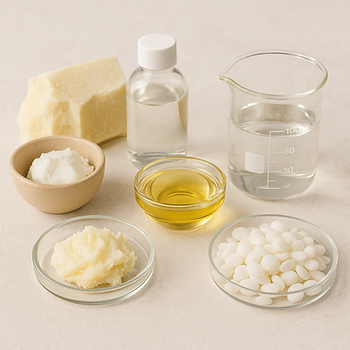
The post every DIY skincare and soapmaking community desperately needs to read.
There’s a conversation that comes up over and over again in maker groups, especially on Facebook. A maker follows a recipe—maybe something they found online, or even a professionally formulated recipe from a formulator they trust—and when their version doesn’t look, feel, or behave like the original, the frustration begins.

They immediately want to know:
“What did I do wrong?”
“What did YOU do wrong formulating it?”
“Why isn’t mine turning out like theirs?”
Here’s the part most makers don’t realize:
You can follow a formula exactly and still end up with a completely different product… if your raw materials, procedure, or temperatures don’t match the original.
This isn’t opinion. This is chemistry.
Let’s break it down in a clear, memorable way that sticks.
1. Raw Materials Are Not All the Same (Even When the Name Is)
This is the #1 reason products fail.
Two ingredients can share the same common name, yet be completely different in:
chemical composition
purity
activity percentage
refinement
molecular weight
fatty acid profile
solubility
the actual INCI name
And if the chemistry is different, the performance is different.
The classic example: “Emulsifying Wax”
Not all emulsifying waxes are created equal:
Polawax = Cetearyl Alcohol + PEG-20 Stearate
Generic E-Wax NF = Cetearyl Alcohol + Polysorbate 60
Cheap Amazon e-waxes = unknown blends, unpredictable behavior
If these emulsifiers aren’t chemically identical, your:
viscosity changes
slip changes
absorption changes
stability changes
and yes, your emulsion can fail
Same name ≠ same ingredient.

2. Supplier Matters More Than You Think
Even when the INCI name matches, the source determines:
purity
manufacturing process
residual solvents
pH
level of refinement
stability
activity percentage
color and odor
compatibility with your system
This is why professionals buy from:
LotionCrafter
Formulator Sample Shop
MakingCosmetics
Ingredientstodiefor
Baraka
Essential Depot
and other reliable suppliers
And why using:
Amazon
Etsy repackaged ingredients
unverified “DIY supply” stores
…often leads to inconsistent results.
If you aren’t using the same raw materials, you aren’t making the same product.

3. INCI Matters More Than Brand Names
Brand names are marketing. INCI names are chemistry.
If a formula calls for Caprylic/Capric Triglyceride, and you substitute:
“MCT oil”
“Fractionated coconut oil”
“Light coconut oil”
“Coconut MCT blend”
You’ve changed the chemical structure.
Here’s the quick breakdown:
Fractionated Coconut Oil
May include C8, C10, C12, and lauric acid
Not standardized
Varies widely between suppliers
MCT Oil (food grade)
Not cosmetic grade
Ratio of fatty acids varies
May contain C12 → changes slip, greasiness, and absorption
Caprylic/Capric Triglyceride (CCT)
Highly refined
Cosmetic grade
Predictable and stable in emulsions and gels
These three are not interchangeable. They behave differently in:
lotions
serums
balms
cleansers
emulsions
gels

4. Procedure Is Chemistry — Not a Suggestion
Even with perfect raw materials, your formula can fail because of:
order of addition
how long each phase mixes
when you introduce sensitive ingredients
how aggressively you use shear
when you cool the formula
hydration timing of gums and polymers
pH adjustments
These factors drastically change:
viscosity
stability
clarity
safety
texture
Examples:
Hydrating xanthan gum incorrectly → stringy, snotty gel
Adding fragrance before emulsification → separation
Adding carbomer before dispersion → lumps and instability
Pouring cool-down actives too hot → degradation/inactivation
Shearing too early → broken emulsion
A tiny change in procedure can drastically change the final product.

5. Temperature Can Make or Break Your Product
Temperature is the silent variable that ruins more formulas than anything else.
Even a 5–10°F difference can swing your results from perfect → disaster.
Temperature affects:
emulsifier melting
gum hydration
surfactant stability
preservative effectiveness
active stability
butter crystallization
gel structure
HP soap consistency
Common temperature mistakes:
Combining phases before emulsifiers fully melt
Cooling too quickly (grainy butters, brittle balms)
Adding extracts/preservatives above their limit
Overheating betaines or surfactants
Pouring fragrance too hot → thins and destabilizes the entire formula
Temperature is not optional. Temperature is part of the formula.

6. The Truth About Oil & Butter Substitution
You may have seen advice online claiming that:
“All oils and butters behave the same in emulsions, so substitutions supposedly won’t affect stability or performance.”
Here’s the accurate, chemistry-based truth:
✔️ Swaps CAN work
—but only in very simple formulas with very forgiving emulsifiers (like Emulsifying Wax NF).
❌ But in real formulation, swaps are NOT universal
Every oil and butter has a unique:
polarity
viscosity
melting point
absorption rate
sensory profile
fatty acid profile
oxidative stability
emulsifier compatibility
Changing the oil or butter can drastically change:
viscosity
slip
drag
absorption
crystallization
stability
after-feel
Oil and butter swaps must be intentional, not automatic.

SANITY CHECKS — Oil/Butter Swap Edition
Before swapping an oil or butter, ask:
What is the polarity of the original oil?
Is the formula relying on esters for slip or speed of absorption?
Is the butter acting as a structuring agent?
Does the emulsifier tolerate polarity changes?
Will oxidative stability shift?
Will viscosity meaningfully increase or decrease?
Is this a simple lotion — or a structured, active-loaded system?
If you can’t answer these, don’t swap it.
CHECKLIST: When Oil Swaps Work vs When They Don’t
✔️ Oil Swaps Usually Work When:
The formula uses E-Wax NF or similar bulldozer emulsifiers
The formula is a very simple beginner lotion
The oil phase is generic (“20% oils”)
No esters or silicones are doing targeted jobs
No butters are providing structure
No electrolytes or polymers are present
The product is NOT performance-driven
❌ Oil Swaps Usually FAIL When:
The formula uses Olivem 1000, Montanov 202, Montanov 68, Ritamulse SCG, etc.
The formula relies on esters for glide, spread, or dry feel
Butters determine viscosity or structure
The system requires polarity balance
It’s a gel-cream, serum, facial product, or haircare system
Electrolytes or polymers are involved
The formula uses precision actives
7. The Maker’s Most Important Realization
If you change:
the ingredient
the supplier
the purity
the INCI
the procedure
the temperature
the oil
the butter
…you are not making the same product the formulator made.

This isn’t a failure of the formula. It’s a failure of equivalency.
Once makers understand this, everything becomes smoother:
fewer failures
fewer “What did I do wrong?” posts
fewer broken emulsions
fewer pH problems
fewer “This formula is bad” complaints
Professional results come from professional practices.
8. The Holy Trinity of Formulation
Every single product you make depends on three pillars:
Ingredients
(the correct material with the correct INCI from a reliable supplier)
Procedure
(order of addition, timing, hydration, shear, pH adjustments)
Temperature
(correct melt temps, combine temps, cool-down temps)
When these three align, your product turns out beautifully.
If even one is off, your results will never match the original.

9. Final Thoughts for Makers
If your product didn’t turn out like the original, it’s almost always because the chemistry changed somewhere along the line.
When you approach formulation like a formulator—not a cook—you get consistent, predictable results.
And that’s where the magic happens.
~Lissa~



Comments