25 Viral Formulation Myths That Keep Spreading — And Why They’re Completely Wrong
- Nov 16, 2025
- 8 min read

A Mega Deep-Dive for Makers, Formulators, and Curious Skincare Lovers
Welcome back to my blog, friends. In today’s post, we’re diving into something the internet desperately needs more of: science-based myth busting for cosmetic formulation.
With TikTok tutorials, AI-generated “recipes,” and Pinterest skincare hacks circulating faster than ever, misinformation has become a real problem in the maker community. These myths don’t just ruin products — they create unsafe formulas, confuse beginners, and spread mistakes disguised as facts.

This is your Soap Chef Sanity Library mega edition — 25 of the biggest, most viral, most persistent formulation myths and the real science behind why they’re wrong.
Whether you're a beginner, an indie brand owner, or a pro formulator, this is your go-to reference guide.
Let’s get into it.

MYTH #1 — Rice Flour = Rice Starch (You Can Substitute Them).
Nope. Rice flour is a whole food. Rice starch is a refined cosmetic ingredient.
Rice Flour Contains:
proteins
fats
fiber
sugars
minerals
moisture pockets
Rice flour also carries significantly higher microbial load and residual enzymes, both of which threaten emulsions and preservation systems.
Rice Starch Contains:
purified carbohydrate
silky, fine particles
predictable performance
Why it matters: Rice flour: destabilizes, spoils, increases microbial load.
Rice starch: mattifies, softens, smooths.
They are not interchangeable.

MYTH #2 — “Yogurt hydrates hot process soap.”
This myth spreads constantly because people confuse batter fluidity with skin hydration, and those are two completely different things.
Let’s untangle it:
⭐ TRUE:
Yogurt can make hot process soap batter much more fluid and pourable —when added after the cook.
Yogurt contains:
water
natural sugars
milk solids
a small amount of fat
These work together to loosen thick, mashed-potato HP batter, making it:
easier to swirl
easier to color
easier to pour into molds
smoother on top
So yes — yogurt absolutely improves batter texture.
⭐ FALSE:
Yogurt does not hydrate or moisturize the finished bar.
None of yogurt’s skin-loving components survive the chemistry of hot process soap.
In a high-heat, high-pH environment:
Lactic acid → neutralized
Probiotics → instantly destroyed
Milk proteins → denatured
Milk fats → mostly saponified
What’s left behind (water + sugars + lactose) influences fluidity, not skin benefits.
⭐ The real truth:
👉 Yogurt improves the batter, not the bar.
It helps you work the soap better —but it does not make the final soap more hydrating, nourishing, or moisturizing.
This is precisely the type of misunderstanding that fuels the misinformation cycle online.

MYTH #3 — Clay Can Be Preserved with Essential Oils.
Absolutely not. Clay is very difficult to preserve because of:
huge surface area
incompatibility with some preservatives
natural microbial load
binding of antimicrobials
Essential oils are NOT preservatives. Ever.
Clays adsorb (bind) preservatives, reducing their availability in the water phase and making broad-spectrum protection more difficult.

MYTH #4 — Aloe Juice Doesn’t Require Preservation.
Aloe is basically a microbial buffet:
water
sugars
proteins
polysaccharides
minerals
Store-bought aloe juices contain preservatives, not self-preserving behavior. Unless the final product’s water activity is below ~0.6 (nearly impossible), aloe = preservation required. Aloe polysaccharides actually feed microbes

MYTH #5 — Essential Oils Can Replace Preservatives.
This myth is dangerous. At safe dermal levels, essential oils: ✘ do not kill bacteria ✘ do not stop mold ✘ do not protect formulas ✘ are not broad-spectrum ✘ are not pH tolerant ✘ not water-phase active
Actual preservatives are required by law for safe water-containing products. Even essential oils with known antimicrobial activity (like thyme or oregano) lose function in emulsions because they aren’t water-phase active where microbes grow
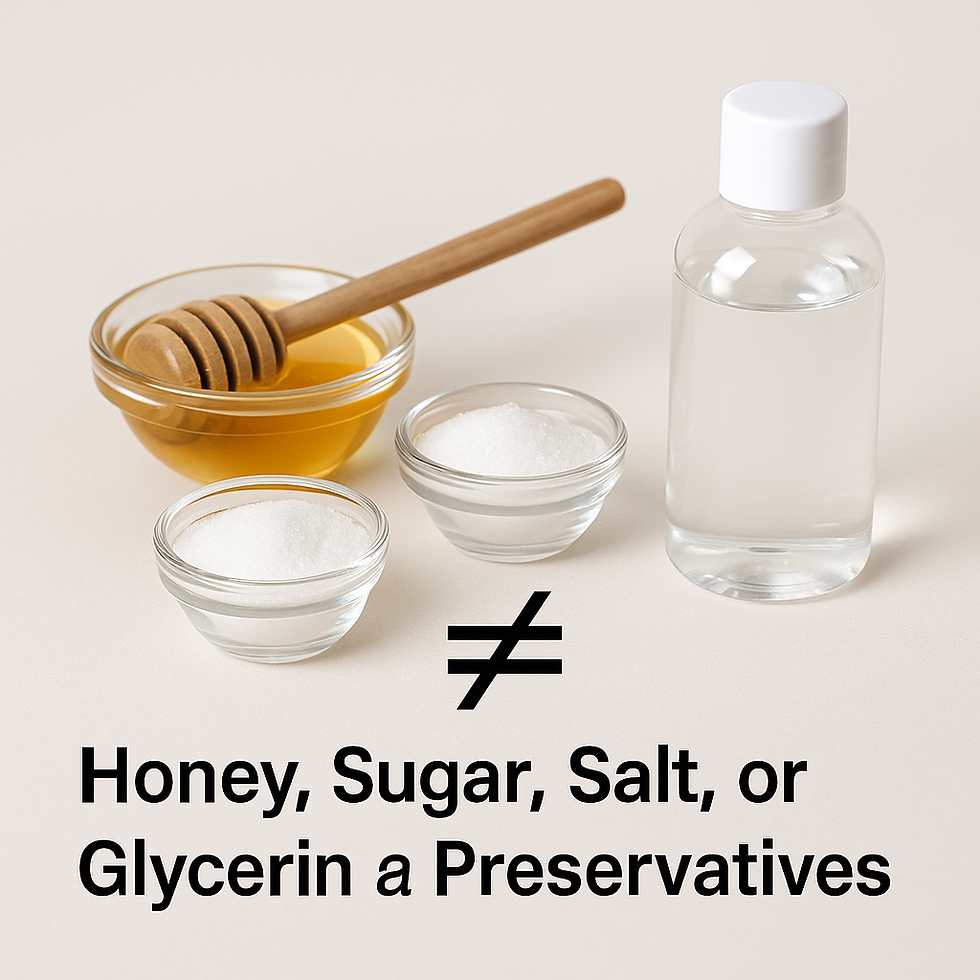
MYTH #6 — Honey, Sugar, Salt, or Glycerin Act as Preservatives.
Only at extremely high, water-binding percentages. Example: pure honey (no water) can resist microbial growth. But a lotion with 1–3% honey? Full microbial risk.
Same for glycerin: At 2–4%, it's hydrating. At ~60%+, it lowers water activity. Not the same. The typical cosmetic % is nowhere near effective

MYTH #7 — “AI can formulate perfect skincare.”
This myth exploded in 2024–2025, and it’s becoming one of the most dangerous misconceptions circulating online.
AI can be a tool, but it cannot replace a trained formulator.
AI can absolutely help with:
organizing formulas
ingredient descriptions
formatting and documentation
performing sanity checks
explaining chemistry concepts
But AI cannot:
interpret COAs or SDS
detect ingredient-grade variability
understand real-world viscosity changes
catch polymer incompatibilities
validate pH-dependent preservatives
predict stability over time
account for shear, heat, or processing variables
perform microbial, PET, freeze–thaw, or long-term testing
AI has zero real-world lab feedback. It cannot see, smell, feel, measure, or test anything it outputs.
**At best, AI alone = risky formulas.
At worst, AI = products that could irritate, sensitize, or compromise the skin barrier because the underlying chemistry wasn’t checked.**
This is why AI-generated skincare must be reviewed, corrected, and validated by an actual formulator. Otherwise, the result is a formula that may look fine on paper but completely collapses in the real world — or worse, causes consumer harm. If you’re going to use AI to formulate, you must already have a solid understanding of raw materials, processing, and ingredient behavior — because without that foundation, you won’t recognize the misinformation AI slips in. Experienced formulators can spot these errors instantly. Beginners usually can’t.

MYTH #8 — Natural = Safe.
Nature creates:
poison ivy
lime-induced photodermatitis
allergens
mold
rancidity
unstable oils
Synthetic ingredients are often:
safer
more stable
more predictable
less sensitizing
Safety ≠ natural. Natural ingredients vary seasonally and batch-to-batch. Natural ≠ non-irritating (e.g., essential oils). Keep in mind oxidation instability of natural oils.

MYTH #9 — More Actives = Better Results.
Too much of anything backfires:
Niacinamide → redness
Retinol → peeling
Vitamin C → irritation & instability
AHAs → barrier damage
Fragrance → sensitization
Use actives at validated levels, not influencer levels.
Synergy vs stacking (too many actives can cancel each other out). There can be pH conflicts and delivery incompatibilities

MYTH #10 — pH Only Matters in Soap.
pH matters in:
serums
toners
lotions
gels
cleansers
masks
peels
anything water-based
pH influences:
efficacy
stability
irritation
preservation
polymer behavior
pH always matters; pH directly affects preservative viability (big beginner mistake)

MYTH #11 — More Butters Make a Lotion Richer.
Nope.
High butter load =
drag
greasiness
instability
soaping effect
Richness comes from:
esters
fatty alcohols
silicone alternatives
structured oil phases
—not just “more butter.”
Excessive butters increase soaping effect and reduce spreadability. High-butter systems require special emulsifier systems

MYTH #12 — Coconut Oil Preserves Products.
Coconut oil ≠ preservative. If it preserved anything, your kitchen jar wouldn’t mold.

MYTH #13 — Just Increase/Decrease Emulsifier to Fix Emulsions.
Emulsifiers have:
required oil-phase ranges
usage windows
compatibility rules
rheology expectations
You cannot “fix” an emulsion by dumping more emulsifier in. This causes the opposite — immediate instability. Increasing the emulsifier can cause soaping and emulsifier crystal bloom (graininess). Emulsifiers have HLB requirements and phase ratio limits

MYTH #14 — “You don’t need a chelator if your water is distilled.”
This myth pops up constantly in beginner groups — and it’s based on a misunderstanding of what chelators actually do.
Chelators aren’t just for “hard water.” They serve multiple important roles inside a cosmetic formula, whether you’re using tap water, distilled water, filtered water, or anything in between.
Chelators such as:
EDTA
Sodium phytate
Sodium gluconate
Phytic acid
GLDA (tetrasodium glutamate diacetate)
(and even weak chelators like citric acid)
…all perform crucial behind-the-scenes work, including:
✔ Boosting preservative efficacy ✔ Preventing rancidity and oxidation ✔ Reducing color change and darkening over time ✔ Improving scent stability ✔ Preventing metal-catalyzed degradation from pigments, botanicals, and equipment ✔ Helping formulas stay fresher, clearer, and more stable
Distilled water only removes the minerals already in the water —it does not address the metals that enter your formula from:
equipment
pigments
clays
botanicals
extracts
fragrances
hydrogen peroxide residues
raw materials that weren’t actually low-metal
even stainless steel processing tools
So yes, even with distilled water, you still benefit from a chelator.
They’re not “optional extras.” They’re stability insurance — especially in modern, active-heavy formulas or natural/plant-based systems that are prone to oxidation.

MYTH #15 — More Fragrance = Stronger Scent.
After a certain percentage:
emulsions destabilize
IFRA limits are exceeded
irritation increases
scent turns sharp or muddy
Long-lasting scent is achieved with:
fixatives
esters
proper dosage
—not overloading FO. High fragrance load can shift emulsion pH or thin viscosity. Ensure IFRA compliance to emphasize safety

MYTH #16 — Natural Surfactants Are Gentler.
Wrong.
Some natural surfactants (like decyl glucoside) are more stripping than synthetics. Glucosides can be more stripping due to high pH and large micelle size
Gentleness depends on:
charge
micelle size
formulation context
pH
—not whether it came from a coconut. Harshness = charge density, not natural origin

MYTH #17 — Xanthan Gum Can Thicken Anything.
This myth refuses to die.
Xanthan hates:
surfactants
electrolytes
acids
esters
alcohol
It destroys foam and ruins textures in many systems. Xanthan can disrupt lamellar phases in lotions; it also causes a slimy or snotty texture in high-% glycerin systems

MYTH #18 — “Botanical extracts automatically add benefits to skincare.”
This myth pops up constantly online — especially in DIY skincare circles where the word “extract” gets treated like a guaranteed dose of plant power.
But here’s the part most beginners don’t realize:
⭐ Most cosmetic-grade extracts sold to makers are mostly solvent — not concentrated plant actives.
When you buy a typical extract from LotionCrafter, Brambleberry, MakingCosmetics, or similar suppliers, you’re usually getting:
90–98% water or glycerin
1–10% actual plant solids
plus a preservative
This is the standard way cosmetic hobbyist extracts are manufactured.
They’re created to be:
shelf-stable
easy to use
water-soluble
compatible with emulsions
beginner-friendly
But not highly concentrated.
⭐ “Extract” does NOT mean “potent.”
Google AI gets confused here because the term “extract” also includes:
standardized 10:1 or 20:1 powders
CO₂ extracts
oleoresins
hydroalcoholic tinctures
nutraceutical-grade extracts
pharmaceutical extracts
Those are different categories entirely.
But the actual extracts most makers are using in lotions and serums?
They’re mostly water or glycerin with a tiny percentage of plant-derived compounds.
⭐ So what does this mean in formulation?
✔ Cosmetic hobbyist extracts add marketing appeal
("infused with green tea," "contains chamomile," etc.)
✔ But they don’t add significant skin benefits unless:
you use them at a very high percentage, OR
you switch to concentrated powder or CO₂ extracts
✔ Water/glycerin extracts also add:
preservation burden
color instability risk
microbial load risk (if not preserved correctly)
batch-to-batch variability
✔ Most importantly:
They rarely deliver meaningful actives in the finished product.
⭐ The truth:
Botanical extracts only offer real skincare benefits when the extract is highly standardized, properly concentrated, and used at an effective percentage. Most ready-made cosmetic extracts are primarily solvent and add much more marketing value than therapeutic value.

MYTH #19 — Oil-Based Products Don’t Need Safety Considerations.
Oil-based ≠ immune to contamination. Water can enter from:
steam
wet fingers
botanicals
powders
Oil-based products still require:
antioxidants
clean processing
packaging considerations
contamination prevention
"Anhydrous” does NOT equal “low-risk". Contamination via condensation is a real consideration (example: bathroom environment)

MYTH #20 — Any Botanical Infusion Is Automatically Safe.
Herbs contain:
spores
bacteria
moisture pockets
Improper infusions risk microbial growth and rancidity.
Safe infusions require:
heat
filtering
antioxidants
airtight storage
testing
Dried botanicals still contain residual water + spores. Infused oils require antioxidants + low-metal containers

MYTH #21 — Vitamin E Preserves Products.
Vitamin E = antioxidant, not preservative. It slows rancidity. It does NOTHING to protect from bacteria, mold, or yeast. Tocopherol blends sometimes contain soybean oil, which is highly unstable — a nuance beginners don’t know

MYTH #22 — More Glycerin Means More Hydration.
After ~5%, glycerin becomes:
sticky
tacky
stringy
destabilizing
moisture-pulling in dry climates
Hydration ≠ drowning the formula in glycerin. Think of the concept of humectant inversion (pulling water from the skin in low humidity)

MYTH #23 — Neutralize Acids with Baking Soda.
Nope.
Neutralization requires:
compatible bases (TEA, NaOH, arginine)
pH curve control
polymer awareness
Baking soda causes carbonate precipitation, destabilizing emulsions

MYTH #24 — Any Oil Can Replace Any Other Oil.
Oils vary by:
polarity
viscosity
fatty acid profile
absorption
oxidation rate
feel
stability
Substituting oils is not plug-and-play. Oils vary in polarity, affecting emulsion stability and sensory. Oxidation rates and shelf life changes vary from oil to oil

MYTH #25 — Stability Testing Is a One-Time Thing.
You need multiple tests:
freeze-thaw
heat
centrifuge
long-term room temp
viscosity tracking
pH drift
packaging compatibility
scent migration
One test ≠ stability.
Stability depends on:
– packaging type
– headspace
– antioxidants
– surfactant system
– polymer choice
Final Thoughts
The maker community is full of creativity and passion — but it’s also full of misinformation that gets repeated until it’s treated as fact.
Formulation is chemistry. Chemistry has rules. And when we work with science, our products become:
safer
more effective
more stable
more predictable
more professional
Misinformation hurts makers. Education empowers them.
~Lissa~


Comments